Knife Forging Tools You Actually Need: The $200 Starter Kit
I’ve been making knives for seven years now, and I still remember the moment I almost quit before I started.
I was 22, broke, and obsessed with knife making. I’d been binge-watching YouTube videos for months—beautiful cinematic shots of pristine shops with $3,000 forges humming quietly, $800 anvils sitting on custom stands, $500 belt grinders with precision controls. Guys in the comments were casually mentioning their $5,000 heat treat ovens and hydraulic presses that cost more than my car.
So I did what any reasonable person would do: I closed the laptop and went to bed, convinced I’d never be able to afford the hobby.
Two weeks later, I was back on YouTube. And that’s when I stumbled onto an old forum post from a guy named Tom who’d forged a dozen working knives using a brake drum, a chunk of railroad track, and about $40 in fittings. The knives weren’t pretty. The edges weren’t perfect. But they were real knives, forged in metal, and they worked.
That post changed everything for me. It taught me a lesson I wish someone had told me upfront: you don’t start with the best tools. You start with the minimum. You make knives. Then you upgrade based on what YOU actually need, not what the YouTube algorithm is selling you.
This is that post. This is the realistic starter kit. And yes, it’s about $200.
The Philosophy First: Why Most Beginners Quit
Here’s a uncomfortable truth that nobody talks about: most people who start knife making quit before their fifth knife. Not because the work is hard, but because they spent $2,000 before they even finished the first blade.
You don’t know yet if you’ll love this. You don’t know if you’ll hate the heat, the repetitive work, the failures, the burns. You don’t know if you’re going to make ten knives and get bored, or if this becomes your entire life. So why would you invest like you already know?
Buy the minimum. Make knives. Learn what frustrates you. Learn what you actually reach for. Then, when you’re on your twentieth knife and you’ve got a waiting list of people who want to buy them—that’s when you upgrade. That’s when you know it matters.
I forged 15 knives on a 60-lb chunk of I-beam I pulled from a demolition site for free before I ever bought a real anvil. And you know what? That piece of steel taught me more about hammer control and heat management than any $800 anvil could have, because I had to work harder. I had to be smarter. I had to understand the fundamentals.
The Actual Kit: $200 Total
1. The Forge: $50-$80
You have two legitimate options here, and both are cheap.
Option A: Brake Drum Forge (About $50)
Any auto shop has brake drums in their scrap bin. Ask around. Many will give you one for free. A used brake drum is a beautiful thing—it’s already shaped, it’s cast iron, and it’s designed to handle heat. You’ll need:
- One brake drum (free to $10)
- Black iron pipe fittings to create a T-shaped air pipe that sits at the bottom ($25-35)
- A hair dryer or old computer fan for forced air (probably free from somewhere)
- Charcoal or coal for fuel ($10-15)
Total: $50 at most. The whole rig sits on concrete blocks, you light the charcoal, turn on the hair dryer, and you’ve got a functional forge.
Option B: Two-Brick Forge (About $80)
If you can’t find a brake drum or you want something more portable, grab two insulating firebricks from a hardware store ($30-40), carve a shallow channel in them with a cold chisel, stack them, and use a Bernzomatic MAPP gas torch ($30-40) to heat your steel directly.
This is slower. It’s less romantic than charcoal. But it works, and it’s dead simple. No forced air, no fuel management, just a torch and brick.
Choose Option A if you’re willing to hunt. Choose Option B if you want immediate results.
2. The Anvil: $0-$50
This is where most beginners get it wrong. They see fancy horn anvils for $400+ and think they need one.
You don’t. You need a flat, hard, heavy piece of steel that doesn’t move. That’s it.
Railroad Track (Free to $20): Walk into any train yard and ask if they have scrap rail. Most do. A 12-18 inch section of track is perfect. It’s flat on top, it’s hard as hell, it weighs enough to do the job. Set it on a wooden stump and bolt or weld it down. Done.
Large Sledgehammer Head ($0-30): Got an old sledge lying around? Cut the handle off, bolt the head to a thick steel plate, and you’ve got an anvil. The flat of the head becomes your striking surface.
Thick Steel Plate ($20-40): A 1-inch-thick steel plate, any shape, mounted solidly to a stand works fine. Not glamorous, but functional.
I used that chunk of I-beam I mentioned—just a 60-lb hunk of steel, standing upright on a wooden post. Could barely see the top of it, had to stand on my tiptoes to work. But my hammer control got sharp real fast because every swing had to count.
3. Hammer: $12-$15 (Probably Already Own)
You don’t need a special forging hammer. Seriously. A 2-lb ball-peen or cross-peen hammer from any hardware store works perfectly fine. You probably already own one.
If you don’t, they’re $12-15. Don’t buy “artisan forging hammers” yet. Those cost $80-150 and do exactly the same job for a beginner. Once you’ve hit hot steel a few hundred times, you’ll know what weight and balance actually feels good in your hand. Then upgrade.
4. Tongs: $20-$40
Buy ONE pair of flat-jaw or V-bit tongs that fit 1/4″ to 3/8″ bar stock. That’s all you need. One pair. Resist the urge to buy a set of six—you’ll use the same pair for your first fifty knives.
Even better: make your own tongs from rebar as your first project. Seriously. It’s perfect practice, and it costs you about $5 in material. You’ll learn hammer control, you’ll understand how to work with hot metal, and you’ll have custom-fit tongs when you’re done.
5. Files: $15-$20
Two files. That’s it.
Get a 10-12 inch bastard-cut flat file ($8-10) and a half-round file ($7-10). These do 90% of your shaping work after forging. Stop laughing—files are criminally underrated. Your first five knives won’t be ground. They’ll be filed. And that’s okay. It teaches you patience and precision.
6. Quench Oil: $5
Don’t buy fancy quench oil. Grab two quarts of canola oil from the grocery store for $5. Pour it into a steel container—a large coffee can or a piece of steel pipe stood upright works great.
Canola oil quenches 1080 and 1084 steel just fine. You’re going to spend $5 here instead of $40 on specialized quench oil, and your knives won’t know the difference.
7. Sandpaper: $10
Wet/dry sandpaper in 120, 220, 400, and 600 grit. You’ll use these for finishing and handle shaping. $10 worth lasts forever if you’re careful.
8. Safety Gear: $15-$20
Safety glasses (not sunglasses—you need actual eye protection), leather gloves that aren’t too bulky (thin leather, not welding gloves, so you can still feel your hammer), and ear protection if you’re working near the forge all day.
This is non-negotiable. Get burned once and you’ll understand why.
What You Absolutely Don’t Need Yet
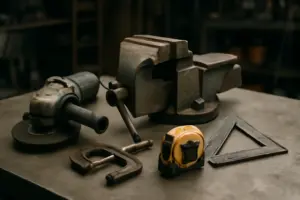
Belt Grinder: Files work fine for your first five to ten knives. A 2×72 belt grinder is amazing and transforms your workflow, but it’s also $300-500 and you don’t need it yet.
Power Hammer: Great once you’re doing dozens of knives. Overkill for the beginning.
Fancy Anvil: We covered this. A lump of steel does everything you need.
Heat Treat Oven: Your kitchen oven works for tempering. It really does. Use it.
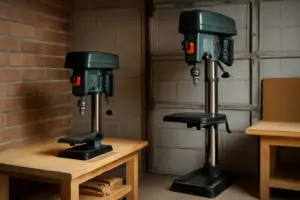
Drill Press: A hand drill works. Slower, yes. But it works.
None of these things matter until you’ve made ten knives.
The Upgrade Path: Do It Right
After five to ten knives, the first real upgrade should be a 2×72 belt grinder in the $300-500 range. This single tool will transform your workflow more than any other purchase. You’ll go faster. Your finishes will look better. You’ll spend less time at the files.
After that? An actual anvil, maybe. Then a better forge setup. Then a heat treat oven if you want precision.
But don’t jump ahead. Make the knives first.
Where to Scrounge
Auto shops: brake drums, heavy scrap steel for anvils
Train yards: railroad track
Machine shops: steel cutoffs
Demolition sites: all kinds of salvage (ask permission)
Flea markets and estate sales: old hammers, tongs, files
Craigslist: free steel, free tools
Spend an afternoon hunting. You’ll find gold.
The Reality
You can forge a functional, beautiful knife with $200 in equipment. I did it. Thousands of people have done it. The internet wants you to believe you need ten thousand dollars and a dedicated shop, but that’s marketing.
Make the first knife. Then the second. Then the fifth. You’ll learn what you actually need, and you’ll have money left over for the upgrades that matter.
Start cheap. Stay humble. Make knives.
—Jake