Diamond Plate vs Whetstone: Which Sharpening System Should You Actually Use?
I’ve been sharpening tools in my shop for about ten years now, and I’ve spent way too much money on edge maintenance. I’ve owned diamond plates, water stones, oil stones, leather strops, ceramic rods, and probably a few things I’ve forgotten about in the back of a drawer. The question I get asked most often—usually by someone standing in front of my bench looking at my stone collection like it’s a puzzle—is simple: “Which one should I actually buy?”
The honest answer is that it depends. But that’s not very helpful, is it? So let me be more specific.
I’m going to walk you through what these systems actually are, how they work, and which one makes sense for your shop. I’m not selling anything here. I use both systems regularly, and I have strong opinions about both—which means I can tell you where each one shines and where it falls short.
What They Actually Are
Diamond Plates (The Modern Option)
Let’s start with something that confused me for years: diamond plates aren’t actually stones. They’re industrial-grade abrasive surfaces—monocrystalline diamonds bonded to a steel or aluminum base. Think of them as metal paddles coated in microscopic industrial diamonds, not geological stones ground down by nature.
The most common brands are DMT (Dia-Sharp), Trend, and Atoma. You’ll find them in a range of grits, typically from 120 grit up to 1200 grit (some premium versions claim 8000 grit, but those get pricey and feel more like a honing surface than a sharpening stone).
They come in several formats:
- Flat rectangular plates (the most common—sizes range from 4″ x 2″ to 8″ x 3″)
- Bench-top cards (thin, flexible versions)
- Handle-mounted paddles
- File-shaped versions for grooves and specialty edges
Traditional Whetstones (The Options)
When people say “whetstone,” they usually mean one of three things, and it’s worth understanding the difference.
Water stones are the Japanese-style option. They’re made from aluminum oxide or silicon carbide particles bonded in a softer matrix. The key word is softer—as you sharpen, worn abrasive particles break free and release new sharp particles beneath. This creates a slurry that helps the cutting action. Water stones range from 120 grit to 30,000+ grit. They cut fast at coarse grits, but they dish (develop a hollow in the middle) with use. You need to flatten them regularly—and yes, many sharpeners use a diamond plate to do this, which is its own kind of irony.
Oil stones are the traditional choice—the Arkansas stones and Norton India/Crystolon stones you see in old woodworking shops. They’re either natural (novaculite from Arkansas) or synthetic (aluminum oxide, silicon carbide). They use honing oil as a lubricant and develop a patina over time. They cut slowly but produce excellent edges. They dish slowly compared to water stones, which makes them more forgiving for beginners.
Natural Japanese water stones sit in a category of their own—expensive, prized, often used for final honing work. I don’t own any because I’m not sharpening samurai swords in my workshop, but I respect them in principle.
How Diamond Plates Work
The basic idea is straightforward: the diamonds on the surface cut the steel. You don’t need to soak them, you don’t need oil, and you don’t need to do much prep work at all.
Here’s the real-world technique I use:
- Place the diamond plate on a flat, non-slip surface (I use a rubber mat so it doesn’t slide around my bench)
- Wet the surface slightly—a few drops of water or a quick rinse. This helps float away the steel particles (called “swarf”) so the diamonds stay exposed and cutting
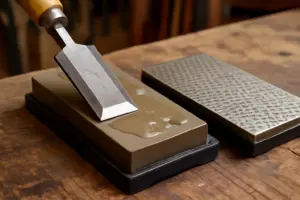
- Hold your tool at the angle you want (typically 20° for kitchen knives, 25-30° for chisels and plane irons), and draw it across the plate with light to moderate pressure
- Work in strokes or small circles. Let the diamonds do the work. Too much pressure doesn’t sharpen faster—it just wears your arm out and can glaze the plate
- Rinse frequently. This is important: as you sharpen, the plate loads up with swarf and steel particles. A loaded plate cuts poorly. A thirty-second rinse under the faucet restores full cutting action
One thing nobody tells you: new diamond plates feel weird for the first few sessions. They feel grabby and aggressive. That’s because the outermost layer of diamonds is irregular, and some break off during initial use. After a break-in period—usually 4-5 sharpening sessions—the plate smooths out and cuts more consistently. Don’t judge a diamond plate by the first use. I almost returned my first DMT because I thought something was wrong with it. Now I know it was just settling in.
Diamond plates stay flat. This isn’t a small thing. Unlike water stones, there’s no dishing, no warping, no need to flatten them on a lapping plate. They’re as flat the day you buy them as they’ll be ten years later.
How Traditional Whetstones Work
Water Stones
Water stones require prep. Most need to soak for 5-10 minutes before use (some premium brands like Shapton are designed to just splash with water, which is convenient). The soaking saturates the stone so the slurry develops properly during sharpening.
They cut fast. At equivalent grit levels, a water stone will cut faster than most diamond plates. As you sharpen, you’re creating a slurry of worn abrasive and steel particles, and this slurry actually assists the cutting action—it’s more efficient than it sounds.
But here’s the catch: they dish. As you work the center of the stone (which is where most sharpening happens), the stone wears and develops a hollow. After a while, you’re sharpening on a convex surface without realizing it. To fix this, you flatten the stone on a lapping plate (often a diamond plate). You need to do this every 10-20 sharpenings or so, depending on how much you use the stone and how aggressive your technique is.
Water stones also need proper storage—some do fine stored dry, others prefer to stay in water to prevent cracking.
Oil Stones
No soaking required. Just apply a few drops of mineral oil (regular old mineral oil—not WD-40, not 3-in-1 oil, not motor oil; mineral oil specifically), and start sharpening. The oil serves as a lubricant and helps prevent the stone from clogging.
They cut slower than water stones at equivalent grit levels, but they’re more stable and don’t dish as dramatically. If you’re patient and don’t mind a longer sharpening session, oil stones produce excellent edges. They’re also more forgiving—you can sharpen in one spot for longer without developing as much of a hollow.
Oil stones are reliable, traditional, and honestly underrated in modern woodworking circles. There’s a reason they’ve been in use for over a hundred years.
The Head-to-Head Comparison
Cutting Speed
Diamond plates win for most situations. At equivalent grit levels, a diamond plate cuts faster than an oil stone and comparable to a water stone. However—and this is important—coarse water stones (120-220 grit) can sometimes match or beat diamond plates for aggressive stock removal on soft steels.
Once you get into fine grits (1000+), the difference becomes minimal. All three systems produce comparable final edge quality, just with different timelines to get there.
Staying Flat
This is where diamond plates have a clear, undeniable advantage: they never dish. This is the single biggest reason I recommend diamond plates to beginners. You buy a diamond plate, and ten years later, it’s as flat as the day you bought it. No maintenance required.
Water stones dish and require periodic flattening. Oil stones dish slowly but still eventually need attention.
If you’re learning to sharpen and you’re already struggling with edge angle consistency, the last thing you need is a stone that’s developing a hollow underneath your tool.
Grit Range and Edge Quality
Water stones win decisively here. You can buy water stones in grits up to 30,000 and beyond, which produces a mirror-polished edge that’s genuinely beautiful. Diamond plates typically max out around 1200 grit (and those premium 8000-grit versions are expensive and don’t feel like true sharpening stones to me).
If you care about a polished, refined edge on your good chisels or plane irons, water stones are the way to go. That final 4000+ grit finish produces something that diamond plates alone can’t match.
Maintenance
Diamond plates: Rinse during use. Scrub occasionally with a stiff brush and dish soap if badly loaded. That’s it.
Water stones: Soak before use, flatten regularly (either on a lapping plate or diamond plate), store properly to prevent cracking. More involved, but many people find the ritual satisfying.
Oil stones: Clean occasionally with mineral spirits if loaded. Keep the surface oiled. Less fussy than water stones but still requires attention.
Cost
For entry-level sharpening:
- DMT double-sided diamond plate (220/400): ~$35-45
- King water stone combo (800 + 4000): ~$50-80
- Norton oil stone combo: ~$25-45
As you move up-market, the costs diverge. A premium Japanese natural water stone can run $500-2000+. Premium diamond plates stay relatively reasonable—you can get a complete diamond plate system (coarse through fine) for under $200.
My Personal Setup (And Why I Did It This Way)
After years of experimenting, here’s what actually lives on my bench:
- Primary sharpening: 2-sided DMT diamond plate (220/400 grit). This handles 90% of my work—touching up dull kitchen knives, resurfacing worn chisels, fixing small chips. It’s fast, reliable, and I don’t have to think about maintenance.
- Finishing work: 1000/4000 King water stone combo. For my good chisels and plane irons, I use the diamond plate to get to a good edge, then finish on the water stones for a polished final result. This gives me the flatness advantage of diamonds with the refinement of water stones.
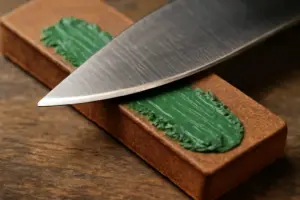
- Final polish: Leather strop with green compound. Not strictly necessary, but it’s the difference between a good edge and one that feels crisp.
I don’t own a single Arkansas stone anymore. Not because they’re bad—they’re not—but because the diamond + water stone combo covers every job in my shop faster and more conveniently. For a different workshop or a different craftsperson, oil stones might be the right call. But for my work? This system is unbeatable.
The Honest Recommendation for Different Situations
If You’re a Beginner
Buy a diamond plate first. Specifically, a 2-sided DMT or Trend plate in 220/600 grit. It costs $30-50, stays flat, teaches you edge-angle consistency without fighting you, and is nearly impossible to damage. You can sharpen almost anything with it. Start here, get comfortable with the technique, then add other stones if you want them.
If You Want Mirror-Polished Edges
You need water stones in the 4000+ grit range. Diamond plates just don’t go there. Once you’ve got the basics down with a diamond plate or oil stone, invest in high-grit water stones for your premium tools. This is the classic combination: aggressive work on diamonds or oil stones, fine finishing on water.
If You’re a General Workshop Sharpener
Diamond plate, hands down. Chisels, plane irons, kitchen knives, drill bits, turning tools—a diamond plate handles it all. Fast, flat, minimal fussing. Move on with your day.
If You’re a Traditional Craftsperson or Purist
Oil stones and water stones. Yes, they’re slower. Yes, you have to pay attention to maintenance. But the process teaches you edge geometry deeply, and there’s real satisfaction in the ritual. Plus, a well-maintained oil stone lasts decades and develops character over time.
Common Mistakes (So You Don’t Make Them)
Diamond Plate Mistakes
- Using too much pressure: Let the diamonds do the work. Pressing hard doesn’t sharpen faster; it just wears out your shoulders and can glaze the plate.
- Never cleaning the plate: A loaded diamond plate is almost useless. Rinse it. Seriously, just rinse it.
- Storing face-down on abrasive surfaces: Diamond plates have a steel or aluminum base. Store them face-up or protected. Storing them face-down on sandpaper or rough surfaces can scratch the base and loosen the diamond coating at the edges.
Water Stone Mistakes
- Sharpening in only one spot: This is how stones dish. Mix up where you sharpen—use the full surface of the stone.
- Not flattening often enough: You’ll sharpen a convex edge and wonder why your freshly sharpened chisel still feels dull. The stone is the problem, not your technique. Flatten it.
- Confusing water stones and oil stones: Don’t soak an oil stone—it will absorb water and swell. Water stones need soaking (usually); oil stones don’t.
Oil Stone Mistakes
- Using the wrong oil: Mineral oil. Not WD-40. Not motor oil. Mineral oil.
- Using too much oil: A light coat is enough. Too much oil creates a slippery surface and prevents proper sharpening.
- Abandoning them too quickly: Oil stones take longer to cut than water stones. If you’re impatient, you’ll think they’re broken. They’re not. Give them time.
The Final Word
There’s no single “best” sharpening system. But there is a best system for you, and it depends on what you’re sharpening, how often you sharpen, and how much you’re willing to invest in the process.
If I could only have one sharpening tool? Diamond plate, no question. Flat, versatile, low-maintenance, and forgiving to learn on.
If I’m spending the next hour carefully polishing an edge on a handplane iron I’ve owned for twenty years? Water stones, all day long.
Pick one, stick with it for at least a month, and you’ll figure out if it’s right for your shop. The worst sharpening system is the one gathering dust because you couldn’t get comfortable with it.