If you’ve spent years working with steel and a MIG welder, picking up a hand plane or a set of chisels feels genuinely humbling. I know because I lived it. As a metalworker starting woodworking tools felt totally foreign — the tolerances are different, the grain fights back in ways metal never does, and the learning curve is steeper than I expected. My first serious wood project was a walnut workbench top to pair with a steel base I’d already fabricated. I figured: how hard could it be? Three ruined boards and about $180 in wasted lumber later, I had my answer.
Here’s the thing nobody tells you when you cross over from metal to wood: your instincts are wrong in the best possible way. You already understand precision, you understand grain structure from working steel, and you respect sharp edges. Those skills transfer. What doesn’t transfer is the muscle memory — you can’t brute-force wood the way you can grind through a weld bead. Wood rewards finesse. Once I accepted that, everything clicked into place.
This post is specifically for metalworkers making the jump into woodworking. I’m not going to cover every tool you’ll eventually want. Instead, I’m covering the five tools that actually got me productive in the first 90 days — the ones I reached for constantly, the ones that didn’t frustrate me, and the ones that made real use of skills I already had.
Why Metalworkers Have a Unique Advantage (and One Big Blind Spot)
Coming from metal fabrication, I already understood tolerances, reading measurements to 1/64″, and respecting the physics of material removal. That background made me faster at learning tool setup than most beginners. A machinist or welder already thinks in terms of fit, finish, and joint integrity. Those concepts translate directly to woodworking joinery.
The blind spot is grain direction. Steel doesn’t have it. Wood absolutely does, and ignoring it is expensive. In my first few months, I chipped out more than one edge by chiseling against the grain — the wood equivalent of running a grinder the wrong way across a weld. Once I started reading grain direction before every cut, my results improved dramatically. That single habit change saved me more material than any tool upgrade.
That said, metalworkers tend to over-clamp and over-force. In woodworking, light pressure and sharp tools beat heavy pressure every single time. My advice: trust sharpness over strength. If the tool feels like it’s fighting you, it probably needs honing — not more muscle.
Tool #1 — A Quality Block Plane
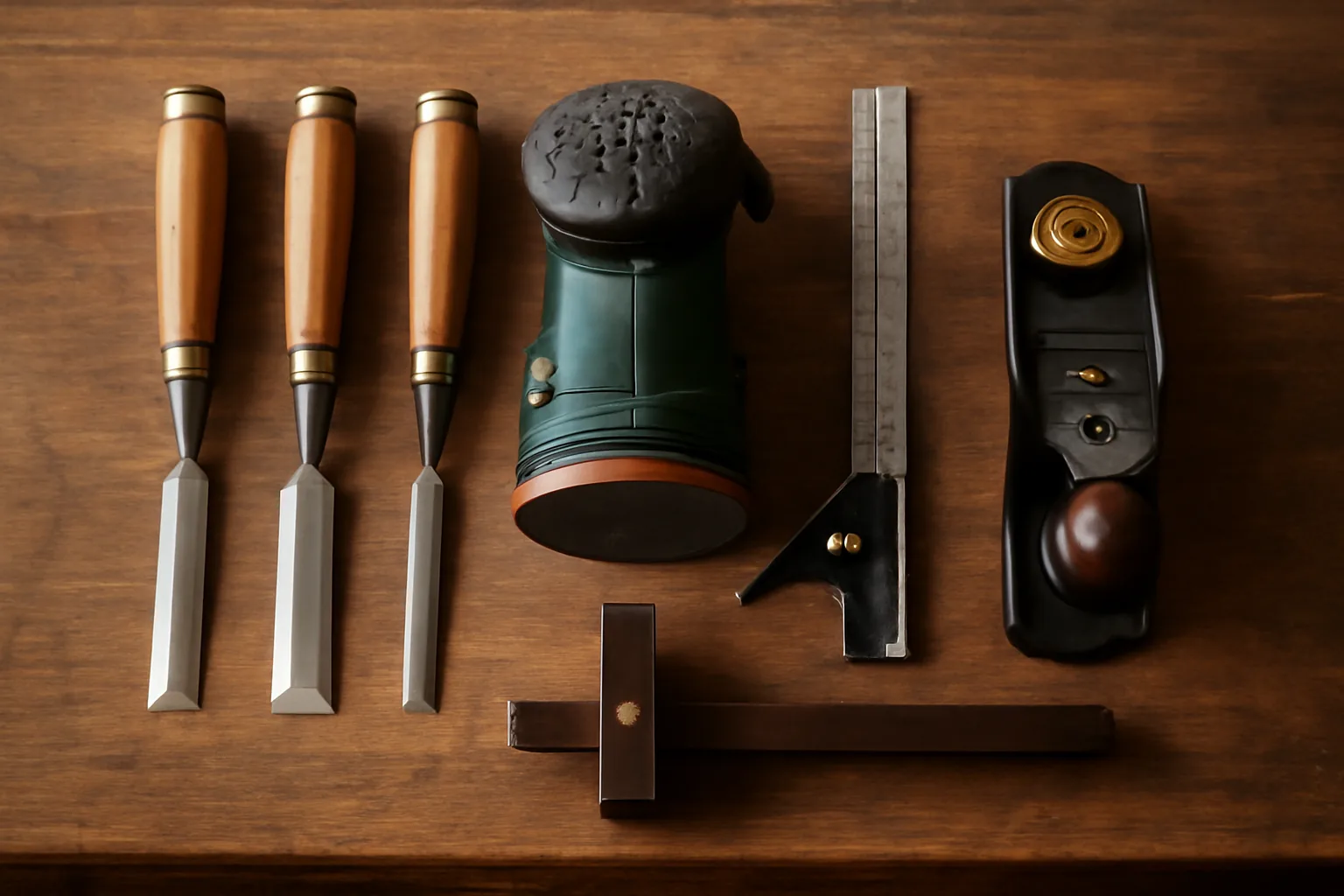
The block plane was the first tool that made me feel competent in the shop. I picked up a Stanley No. 60-1/2 for around $55, and after tuning the blade — flattening the back on 220-grit sandpaper on glass, then honing to a 25-degree bevel — it became my most-used hand tool in the first three months. For metalworkers, tuning a plane feels intuitive. You’re adjusting tolerances, setting a blade depth, and dialing in a mechanical system. That’s familiar territory.
A block plane excels at end grain, chamfering edges, and fitting joints. Specifically, it’s what I used to sneak up on the final fit of my bench top breadboard ends — shaving maybe 0.005″ per pass until the joint closed without gaps. Try doing that with a belt sander. You can’t. The control a hand plane gives you is unmatched for final fitting.
Expect to spend $40–$80 for a decent new block plane. Avoid the sub-$30 hardware store options — the castings are rough and the blades are soft. A used Stanley or Record from an estate sale is often a better deal than a new budget plane. Just inspect the sole for warping with a straightedge before you buy.
Tool #2 — A Reliable Marking Gauge
Metalworkers use scribes. Woodworkers use marking gauges. The concept is identical — you’re scoring a reference line at a set distance from an edge. However, a marking gauge in wood actually severs fibers rather than just scratching a surface. That distinction matters more than you’d think for clean joinery.
I learned this the hard way on my first mortise-and-tenon joint. I used a pencil line instead of a scored line, and my chisel kept wandering to one side of it. When I switched to a wheel-style marking gauge — I use a Veritas Wheel Marking Gauge, which runs about $55 — my joints tightened up immediately. The scored line creates a tiny shoulder the chisel registers against. That’s the kind of mechanical advantage that makes sense to a fabricator.
For budget-minded starters, a basic wooden mortise gauge runs $15–$25 and works fine for most tasks. Just make sure the beam locks securely. Slop in the fence setting means inaccurate lines, and inaccurate lines mean sloppy joints. No amount of skill recovers from a bad layout line.
Tool #3 — A Reliable Crosscut Hand Saw
I know what you’re thinking — don’t I have a miter saw? Yes. I have a 12″ Dewalt sliding compound. However, for dimensioning rough lumber in a small shop, a sharp Japanese pull saw gives me more control with less setup. Specifically, I use a Suizan 9.5″ Ryoba double-edge saw, which costs about $30 on Amazon and stays sharp for a surprisingly long time.
The pull-stroke cutting action of a Japanese saw feels odd for about 20 minutes, then becomes completely natural. For metalworkers who’ve used hacksaws, the logic is the same — cut on the pull stroke for better control and straighter lines. The thin kerf also means less material waste, which matters when you’re working with $12-per-board-foot walnut or white oak.
A good crosscut hand saw also teaches you to read grain and feel resistance — skills that make you a better overall woodworker. I still reach for mine when I need a quick cut without dragging out the miter saw, or when the workpiece is too awkward to clamp safely on the machine. It’s a tool I underestimated completely and now use almost daily.
The Right Chisels for a Metalworker Starting Woodworking Tools
This is where I’m going to spend the most time, because chisels are where metalworkers’ instincts both help and hurt. The help: we understand steel hardness, edge geometry, and the importance of flat reference surfaces. The hurt: we tend to hammer too hard and skip the sharpening steps because we’re used to grinding metal, not honing edges.
After trying three different sets in my first year — including one cheap set that chipped on the second use — I landed on the Narex 6-piece Woodworking Chisel Set (853053) and haven’t looked back. The set includes 6mm (1/4″), 10mm (3/8″), 12mm (1/2″), 16mm (5/8″), 20mm (13/16″), and 26mm (1-1/16″) bevel-edge chisels in a wooden presentation box. That size range covers virtually every joint I’ve cut in two years of woodworking projects.
The steel on these is Cr-Mn (chrome-manganese) tool steel, hardened to approximately 59 HRC. For metalworkers, that’s a meaningful spec — it’s hard enough to hold an edge through extended use but not so brittle that it chips on figured grain. I’ve used mine on white oak, cherry, hard maple, and even some reclaimed Douglas fir with old nail holes nearby. They’ve held up without any chipping issues when used correctly.
Why I Recommend This Specific Narex Set
Out of the box, the backs needed about 20 minutes of flattening on a diamond plate. That’s normal for any chisel in this price range — around $80–$90 for the full six-piece set. After that initial setup, they’ve needed only regular stropping on leather to stay sharp. The handles are beech wood with a plastic ferrule and striking cap, which means you can use a wooden mallet without mushrooming the handle.
In my experience, this set hits a quality level that punishes sloppy technique rather than hiding it. That’s exactly what a metalworker needs when crossing over — tools that tell you when you’re doing something wrong. Cheap chisels chip and mislead you. These don’t.
If you’re not ready to commit to a six-piece set, the Narex Bevel Edge Chisel Set of 4 pieces is a solid starting point. You get fewer sizes but the same steel quality and handle construction. I’d call it the right move if your budget is tight or if you’re still unsure how much hand-tool work you’ll actually do. Either way, Narex is the brand I’d stake my recommendation on at this price point.
Tool #5 — A Sharpening System You’ll Actually Use
Sharpening is the skill that separates good woodworkers from frustrated ones. Every metalworker I’ve talked to who tried woodworking and quit said the same thing: “The tools just didn’t cut right.” In almost every case, the issue wasn’t the tools. It was dull edges. Sharp edges in woodworking are sharper than anything most metalworkers have touched — we’re talking a polished 8,000-grit edge that can shave arm hair cleanly.
My system is simple: a coarse diamond plate (DMT D8C, around $55) for flattening backs and reshaping bevels, a medium-grit waterstone (1,000 grit) for general sharpening, and a leather strop loaded with green honing compound for final polishing. Total investment: about $90–$110. That system handles chisels, plane blades, and marking knives.
For a metalworker, the motion takes some adjustment — you’re maintaining a consistent bevel angle by feel, not by jig, unless you use a honing guide. I’d recommend a Veritas MkII honing guide ($35) for the first few months. It removes the angle variable entirely while you build the feel. As a result, you spend your learning curve on the craft, not on re-grinding chipped bevels.
When to Call in a Pro (or Ask a More Experienced Woodworker)
Woodworking doesn’t have the same safety codes as electrical or structural work, but there are real limits to what you should DIY without guidance. Specifically, if you’re building load-bearing furniture — bed frames, shelving rated for heavy loads, or staircases — you need to understand joinery engineering, not just technique. A mortise-and-tenon joint has specific proportions for strength; a dowel joint is not always a safe substitute, regardless of what YouTube says.
I’d also strongly recommend spending a half-day with a more experienced woodworker before you invest heavily in power tools like table saws or band saws. The kickback potential on a table saw is not theoretical — it’s serious and fast. The Woodworking Machinery Manufacturers of America (WMMA) and SawStop’s own research put table saw injuries at over 33,000 annually in the U.S. Get proper instruction before you solo on stationary power tools.
Hand tools, however, are genuinely forgiving for self-teaching. A sharp chisel moving at your hand’s speed is far more controllable than a spinning blade. Start there, build confidence, then add machines later. That sequence has worked well for everyone I’ve seen make this transition successfully.
Final Thoughts — The Best Starting Kit for a Metalworker Starting Woodworking Tools
Two years into this crossover, I can say confidently: the skills transfer better than you’d expect, and the frustrations are shorter-lived than they feel in the moment. The five tools I’ve covered — a block plane, marking gauge, pull saw, quality chisels, and a real sharpening system — cost me roughly $250–$350 total to get right. That’s less than one decent welding helmet, and it opened up an entirely new category of projects in my shop.
The Narex 6-piece chisel set remains the single best purchase I made in that early period. It gave me professional-level feedback without a professional-level price. If you’re serious about making this transition, start there. You won’t outgrow them quickly, and they won’t frustrate you the way cheap sets do.
The biggest lesson from my first 90 days in wood: slow down, sharpen often, and read the grain before every cut. The rest follows naturally — especially if you already think like a fabricator.
This post contains affiliate links. As an Amazon Associate, I earn from qualifying purchases at no extra cost to you.