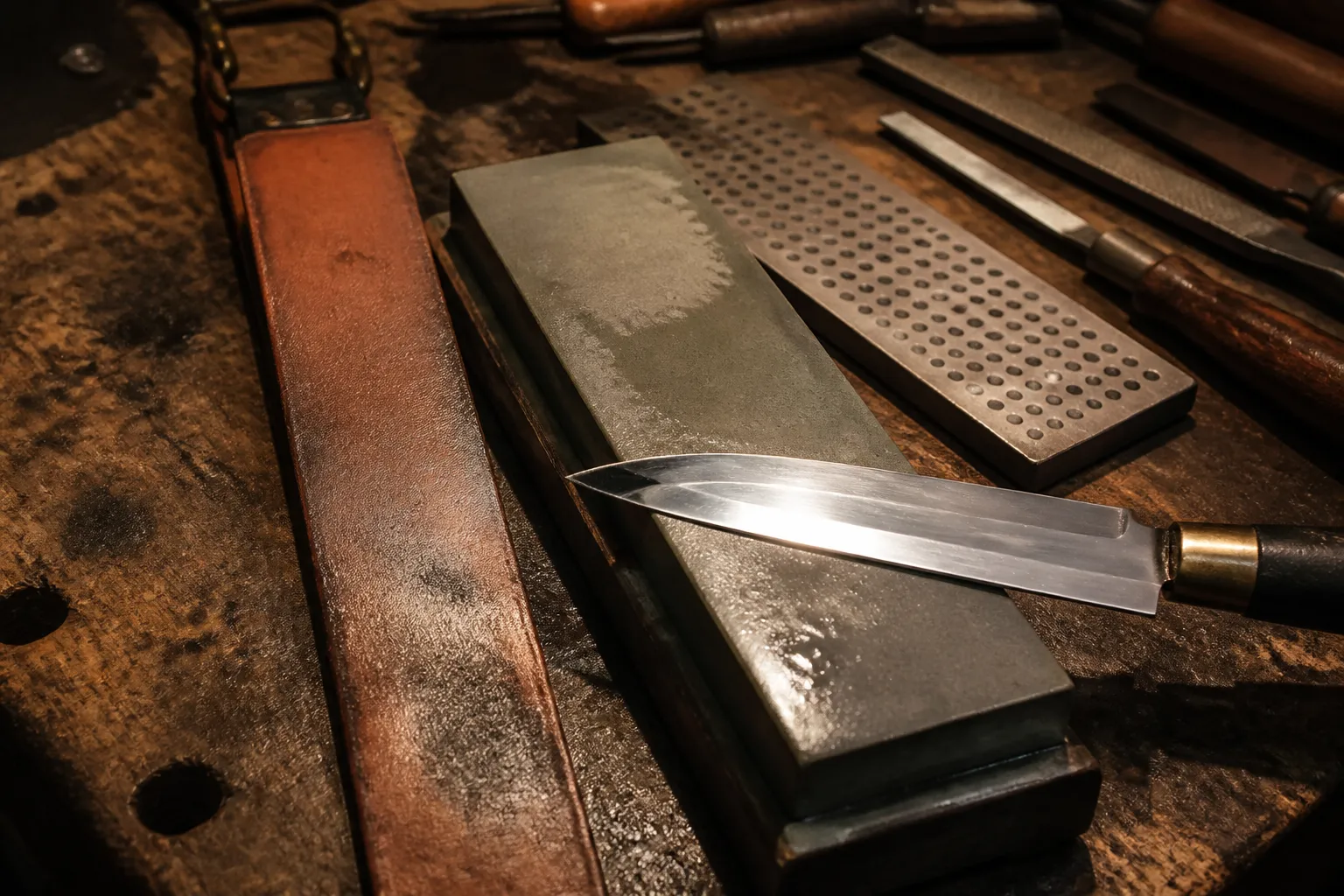
No universally optimal sharpening methodology exists. However, an optimal approach for your specific situation certainly does, contingent on your sharpening duties, frequency, and resource commitment tolerance.
Should I restrict myself to one instrument? Diamond plate, without hesitation. Stays flat, covers everything, demands minimal fussing, and welcomes newcomers warmly.
When I’m devoting two hours perfecting the edge of a hand plane iron accumulated across decades? Water stones exclusively.
Select something, practice it consistently for thirty days, and you’ll understand whether it matches your workshop reality. The only truly unsuccessful sharpening method is the one gathering dust because you never developed comfort with it.
| Characteristic | Diamond Plate | Water Stone | Oil Stone |
|---|---|---|---|
| Grit Range | 120–1200 grit | 120–30,000+ grit | varies by type |
| Surface Flatness | Never dishes | Dishes with use | Dishes gradually |
| Flattening Required | Never | Every 10–20 uses | Infrequent |
| Preparation | Light water rinse | 5–10 min soak | Light mineral oil |
| Sharpening Speed | Fast | Fast to very fast | Deliberate |
| Mirror Finish Capability | Up to 1200 grit | 4000+ grit | Possible but slower |
| Maintenance | Rinse regularly | Soak, flatten, store carefully | Occasional solvent clean |
| Typical Starter Cost | $30–50 | $50–80 | $25–45 |
Diamond Plate vs Whetstone: Which Sharpening System Should You Actually Use?
Most people think all sharpening surfaces work basically the same way—rub your blade on stone, get a sharp blade back. That’s only half true, and it’s why so many woodworkers end up frustrated, broke, or both. I’ve spent the last dozen years keeping edges functional in my two-car garage, cycling through every sharpening contraption you can imagine: diamond plates, water stones, oil stones, leather strops, ceramic honing rods, and probably some mysterious abrasive I’ve since blocked out of my memory. The question that lands on my bench most often—usually from someone staring at my accumulated stone collection like they’re deciphering an ancient language—boils down to this: “What should I actually be using?”
The short version? It depends. Not especially useful advice, I realize. Let me dig deeper.
I’m going to break down what these systems really are, the mechanics behind how they function, and which approach fits your particular workshop. There’s nothing I’m pushing here. Both systems earn regular rotation in my work, and I’ve got decided views on each one—the kind that let me show you where each truly excels and where each struggles.
Understanding Your Options
Diamond Plates (The Contemporary Choice)
Here’s something that puzzled me for years: diamond plates are not actually stones at all. They’re precision abrasive surfaces consisting of monocrystalline diamonds adhered to either steel or aluminum backing. Imagine a metal plate coated with microscopic industrial diamonds—far removed from the stones that nature carved and time weathered.
The familiar names in this category are DMT (Dia-Sharp), Trend, and Atoma. You’ll encounter them across a spectrum of grits, typically spanning from 120 grit through 1200 grit (some premium editions claim 8000 grit capability, though these carry higher price tags and perform more as finishing instruments than actual sharpeners).
They’re manufactured in multiple configurations:
- Rectangular flat surfaces (the standard type—dimensions generally span from 4″ x 2″ up to 8″ x 3″)
- Thin bendable sheets (bench-top versions)
- Paddle styles with handles built in
- Specialized shapes for edges and grooves
Conventional Whetstones (The Categories)
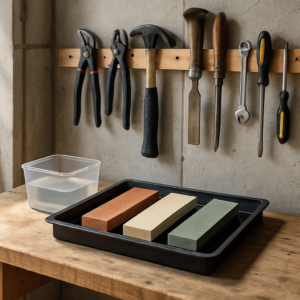
When someone references a “whetstone,” they’re typically describing one of three distinct products, and the distinctions matter.
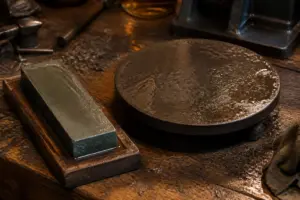
Water stones represent the Japanese tradition. Their composition combines aluminum oxide or silicon carbide particles within a relatively soft binding material. The word soft carries significance here—as sharpening progresses, spent abrasive breaks away and exposes fresher sharp particles beneath the surface. This mechanism generates a slurry that accelerates the sharpening action. Water stones come in grits from 120 up to 30,000 or higher. Coarser grits work swiftly, but these stones undergo dishing—they form a depression running through their middle—with extended use. Maintenance requires periodic flattening, and ironically, many sharpeners employ a diamond plate for this task.
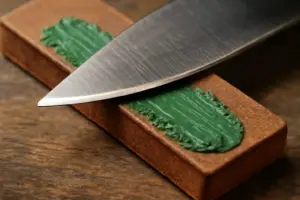
Oil stones represent established tradition—the Arkansas and Norton India/Crystolon products inhabiting vintage woodworking spaces. These consist of either natural stone (novaculite sourced from Arkansas) or manufactured materials (aluminum oxide, silicon carbide). Honing oil functions as the lubricant, and the surface matures with a working patina. They advance slowly through material but deliver remarkable edges. Compared to water stones, they resist dishing much more gracefully, which provides more tolerance for developing sharpeners.
Natural Japanese water stones occupy their own specialized niche—costly, sought-after, commonly reserved for finishing strokes on premium tools. I haven’t invested in these since my shop doesn’t involve Japanese blade work, but I recognize their merit in principle.
The Mechanics of Diamond Plates
The concept is uncomplicated: the diamond coating cuts through steel. They require no soaking, no oil preparation, and minimal setup routine.
Here’s the practical workflow I follow:
- Position your diamond plate onto a level, textured surface (I secure mine with a rubber mat so it won’t shift across my workbench)
- Apply water lightly—a splash or gentle rinse works fine. This floats away steel debris (technically called “swarf”) and exposes fresh diamond points
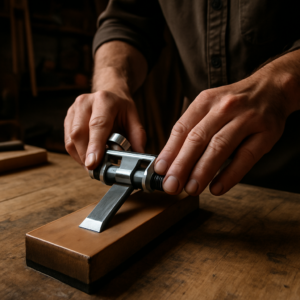
- Position your tool at your preferred angle (roughly 20° for culinary blades, 25-30° for chisels and plane irons), then stroke it across the plate applying gentle to moderate force
- Sharpen using strokes or rotating motions. The diamonds handle the cutting—excessive pressure doesn’t accelerate results, only tires your muscles and risks glazing the surface
- Wash repeatedly. This step matters: as you work, steel particles and swarf coat the plate. An accumulation impairs the cutting function. A brief thirty-second rinse restores the plate’s effectiveness
Something overlooked in most guides: fresh diamond plates behave strangely the first few uses. They grab aggressively and feel unstable. This occurs because the topmost diamond layer is imperfect, and some particles fracture during initial sharpenings. After a settling phase—normally 4-5 sessions—the plate quiets down and performs consistently. Judge your plate only after this break-in concludes. I nearly sent back my initial DMT believing something was defective. Now I understand it was merely acclimating.
Diamond plates maintain their flatness indefinitely. This isn’t trivial. Unlike water stones, they won’t form depressions, warp, or require flattening on specialized equipment. Your diamond plate remains as level the day it arrives as it will be a decade afterward.
The Operation of Conventional Whetstones
Water Stones
Water stones demand preparation. Most require dunking for 5-10 minutes beforehand (certain premium brands such as Shapton skip this, just wanting a water spray, which streamlines the procedure). This immersion saturates the internal structure so slurry formation happens correctly when sharpening starts.
Their cutting rate impresses. At identical grit values, a water stone outpaces most diamond plates. During sharpening, you’re building a slurry from abraded material and steel particles, and this slurry enhances the cutting mechanism—it’s more productive than it appears initially.
The limitation emerges here: dishing happens. As you concentrate work in the stone’s middle section (the natural focus zone), the material diminishes and hollow forms. Eventually you’re sharpening against a curved surface without recognizing it. Correction involves flattening on a lapping instrument (frequently a diamond plate). Most practitioners need flattening every 10-20 uses depending on intensity and approach.
Water stones also necessitate thoughtful housing—some tolerate dry storage fine, others benefit from remaining water-submerged against fracture risk.
Oil Stones
Submersion? Not required. Simply add a light measure of honing mineral oil (unadorned mineral oil specifically—bypass WD-40, multipurpose oils, conventional motor oil; mineral oil explicitly), then begin. The oil lubricates and protects against buildup.
They operate more deliberately than water stones when grits match, but they reward that patience with remarkable results. Extending a sharpening session on one spot produces less surface depression. For those unbothered by lengthened work, oil stones deliver exceptional finishes. Their reliability and neglected reputation in contemporary woodworking communities merit reconsideration. They’ve remained the preference for longer than a century for legitimate cause.
Comparing Them Side by Side
Sharpening Velocity
Diamond plates perform faster in most contexts. At equivalent abrasiveness, a diamond plate outcuts an oil stone and matches a water stone closely. However—and this distinction proves critical—coarse water stones (120-220 grit) occasionally match or surpass diamond plates for substantial metal removal on softer alloys.
Once you climb to finer grits (1000 and beyond), variations reduce dramatically. All three produce comparable final outcomes, varying only in how long the work requires.
Surface Flatness
Here diamond plates own the advantage decisively: they never form hollows. This single characteristic is my prime reason for steering beginners toward diamond plates. Purchase one, return in ten years, and it maintains identical flatness. Zero upkeep.
Water stones develop hollows requiring recurrent flattening. Oil stones do likewise, though much more gradually.
When you’re starting out and already wrestling with keeping your edge at a steady angle, the last complication is a stone developing a bowl shape beneath your blade.
Grit Selection and Final Edge Caliber
Water stones prevail markedly here. Available in grits exceeding 30,000, they create mirror-finished edges of genuine aesthetic appeal. Diamond plates typically stop around 1200 grit (those premium 8000-grit varieties cost substantially and feel less like proper sharpeners to my estimation).
Desiring a lustrous, refined finish on treasured chisels or plane irons? Water stones represent the answer. Finishing above 4000 grit delivers refinement that diamonds alone cannot replicate.
Upkeep Demands
Diamond plates: Rinse between sessions. Brush aggressively with bristles and soap periodically if accumulation grows thick. Nothing else.
Water stones: Soak beforehand, flatten periodically (using a lapping plate or diamond plate), store with attention to prevent fracturing. Greater involvement, though some craftspeople savor the ceremonial elements.
Oil stones: Occasional cleaning with solvent if debris loads up. Maintain an oiled finish. More demanding than diamonds but less fussy than water.
Expense Considerations
For foundational setups:
- DMT dual-surface diamond plate (220/400): roughly $35-45
- King dual-stone water system (800 + 4000): roughly $50-80
- Norton dual-surface oil stone: roughly $25-45
Costs separate significantly at premium tiers. An exceptional Japanese water stone commands $500-2000 or beyond. Premium diamond plates remain relatively budget-friendly—assemble a complete diamond collection (coarse through refined) for under $200.
What Occupies My Bench (And the Reasoning Behind It)
Following years of testing, my bench carries:
- Primary work: Dual-surface DMT diamond (220/400 grit). Covers roughly 95% of daily demands—refreshing kitchen blade edges, resurfacing worn chisels, repairing small defects. Swift, dependable, and needs no special consideration.
- Detailed finishing: Combo water stone (1000/4000 King brand). When I’m addressing my superior chisels and hand planes, I employ the diamond for the foundational edge, then transition to water stones for that polished final appearance. This pairing grants the flatness stability of diamonds plus the refinement of water.
- Ultimate sharpness: Leather strop dressed with compound. Technically optional, though it separates an acceptable edge from one that truly sings.
Arkansas stones? None remaining in my collection. Not because they disappoint—they honestly don’t—but my diamond-and-water combination accomplishes every task faster and with less friction. Another shop, another builder, might discover oil stones perfectly suited. For my environment? Unbeatable.
What I’d Tell You (Depending on Your Situation)
Starting Fresh
Acquire a diamond plate initially. Target a 2-surface DMT or Trend in 220/600 configuration. Investment runs $30-50. Stays perfectly flat, coaches you toward consistent angle work without resistance, and survives almost any mishap. It handles virtually everything. Build competency here, then branch into alternatives if desire strikes.
Pursuing Highly Polished Finishes
You’ll require water stones at 4000+ grit levels. Diamonds simply cannot approach this territory. Once fundamentals are solid via diamond or oil work, splurge on high-grit water stones reserved for valued implements. The established approach—fast work on diamonds or oil, careful finishing on water—proves ideal.
Running a Typical General Shop
Diamond plate, unambiguously. Whether honing chisels, plane irons, kitchen cutlery, drill bits, or turning implements—a single diamond plate tackles everything. Swift, level, minimal complication. Complete the task and progress forward.
Embracing Heritage Methods or Philosophical Preference
Water and oil stones. Yes, pace slows. Yes, care becomes necessary. Yet engaging this approach deepens understanding of edge composition, and the ritual provides genuine satisfaction. A carefully maintained oil stone persists for ages and grows character through service.
Missteps Worth Avoiding
Diamond Plate Pitfalls
- Excessive downward force: The diamonds perform the work independently. Pressing intensely accomplishes nothing except exhausting yourself and potentially coating the surface with a glaze.
- Neglecting to clean: A debris-laden diamond plate barely functions. Regular rinsing restores performance.
- Face-down storage on coarse materials: Diamond plates have steel or aluminum bases vulnerable to marking. Store facing upward or covered. Face-down placement on sandpaper or textured surfaces scratches the base and loosens edge-bond diamonds.
Water Stone Pitfalls
- Concentrating in one region: This produces dishing. Distribute your sharpening—employ every area of your stone’s face.
- Skipping timely flattening: You’ll hone against a convex surface and wrongly conclude your blade work failed. The stone itself requires correction.
- Mixing up stone categories: Soaking an oil stone ruins it—water penetrates and causes expansion. Water stones demand soaking (customarily); oil stones reject it.
Oil Stone Pitfalls
- Reaching for incorrect oil products: Honing mineral oil only. Not WD-40 substitutes. Not motor products. Mineral oil.
- Applying excessive quantities: A thin coat suffices. Oversaturation creates slickness and undermines sharpening effectiveness.
- Discarding them prematurely from impatience: Oil stones work methodically compared to water alternatives. Assuming brokenness after brief exposure means abandoning a quality tool prematurely.
A Note on Names: Whetstone, Water Stone, Oil Stone
The vocabulary trips people up, and it matters when you are searching for one. Whetstone is the general term for any stone used to sharpen an edge — it comes from “whet,” meaning to sharpen, and has nothing to do with water. A water stone is a whetstone that uses water as its lubricant. An oil stone uses oil. So every water stone is a whetstone, but not every whetstone is a water stone.
Throughout this comparison, when I weigh a diamond plate against a whetstone, the whetstone I have in mind is a water stone, because that is what most people sharpening chisels and plane irons at home are actually using. If you are running oil stones, the diamond-versus-stone trade-offs are broadly the same, with the flatness advantage of diamond mattering slightly less.
Diamond vs stone sharpening, in one paragraph
Diamond cuts faster, stays dead flat, and needs no soaking — but the surface wears and it cannot be resurfaced. A stone cuts slower, dishes with use, and needs flattening — but it can be flattened forever and takes a finer polish at the top grits. If you want one and only one, a diamond plate is the more forgiving choice for a beginner.
Frequently Asked Questions
Do diamond plates need soaking before sharpening?
No. Diamond plates require no soaking, oil preparation, or special setup routine. Simply position your plate on a level surface, apply water lightly to float away steel debris, then sharpen. They’re ready to use immediately.
Why does my new diamond plate feel unstable?
Fresh diamond plates behave strangely during their first few uses because the topmost diamond layer is imperfect and some particles fracture during initial sharpenings. After a settling phase of normally 4-5 sessions, the plate quiets down and performs consistently.
How often do water stones need flattening?
Most practitioners need flattening every 10-20 uses depending on intensity and approach. Dishing happens as you concentrate work in the stone’s middle section, and correction involves flattening on a lapping instrument, frequently a diamond plate.
What grit water stones create mirror finished edges?
Water stones exceeding 4000 grit deliver refinement and create mirror-finished edges of genuine aesthetic appeal. Finishing above 4000 grit produces the lustrous, refined finish that diamond plates typically cannot replicate.
Sources and further reading
About This Article

Written by Garrett Dunn. Hobbyist metalworker and garage workshop builder. I restore old tools, weld custom furniture, and document my projects and mistakes so other makers can learn from both. More about this site.
Scope and limits. Garrett is a hobbyist metalworker, not a certified welder or machinist. Welding, grinding, and solvent work carry real injury risk — use the correct PPE and ventilation, and follow the manufacturer safety guidance for your own equipment.
Verify this against a primary source
Specifics change, and your situation may differ from the one described here. These are the authorities worth checking directly:
- OSHA — machine guarding, PPE and shop safety standards
- American Welding Society — welding procedure and safety standards