
Types of Vises Every Shop Should Know: Machinist, Woodworking, Leg, Pipe, and More
If you’ve spent any time in a workshop—whether you inherited a vise from a relative, picked one up at a flea market, or you’re standing in the hardware store trying to figure out what the heck you actually need—you’ve probably noticed that vises aren’t all the same. They come in wildly different shapes, sizes, and configurations, and there’s a good reason for that: different jobs demand different tools.
I learned this the hard way. I grabbed what I thought was a “vise” for my first bench setup, bolted it down, and then spent months wondering why it felt wrong for half the things I wanted to clamp. Turns out I was using a tool designed for one specific task and expecting it to do everything. Once I understood the categories—what each type was really designed for and why—everything clicked into place.
In this post, I’m laying out the main types of vises you’ll encounter in a shop, what makes each one special, and how to tell them apart. Whether you’re trying to identify what you already own or figure out what to buy next, this is your reference guide.
The Machinist’s Vise (Bench Vise)
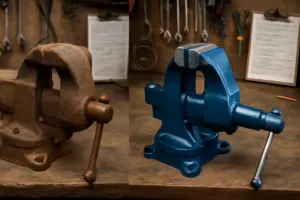
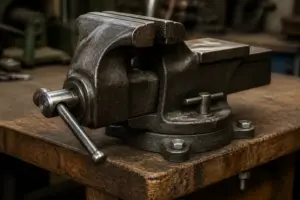
What it looks like: This is the most common vise you’ll see. It’s cast iron, sits on a sturdy base (often a swivel base), and has two parallel hardened steel jaws with a cross-hatch or serrated texture. The jaw faces are flat and square, and they close via a big handle or screw mechanism on one side. Most have a spring-loaded quick-release lever built into the screw assembly.
What it’s actually for: The machinist’s vise is the workhorse of general metalworking. You use it for filing, drilling, grinding, test-fitting parts, hand-shaping, and holding work while you do detail work. It’s designed to grip metal securely without slipping, and the hardened jaws won’t deform under the kind of clamping force you need for metal fabrication. The swivel base is brilliant because you can rotate the whole assembly to angle your workpiece without unclamping.
Key design features: Parallel hardened jaws, spring quick-release, swivel base, and a screw-driven clamp with an acme thread (the big square-profile threads you can see). The jaw width matters here—common sizes are 3″, 4″, 5″, and 6″ wide. Larger jaws give you more gripping surface for bigger stock; smaller widths are more precise for delicate work.
How to identify it: If the vise is sitting on your bench right now and it has two flat, serrated steel jaws that close straight together and a spring that helps snap the loose jaw back open when you release the screw, you’ve got a machinist’s vise. It’s the most common type by a mile.
The Leg Vise (Blacksmith’s Post Vise)
What it looks like: This is a totally different animal. The leg vise has two jaws, but one jaw is movable and one is fixed to a long iron leg that extends downward. The whole thing sits on that leg, which either bolts to the shop floor or rests on a thick wooden mounting block. There’s usually no spring, no quick-release—just a screw mechanism or cam that you work by hand. The body of the vise is often ornate cast iron, and there might be an integrated small anvil surface built into the fixed jaw.
What it’s actually for: The leg vise is designed for hot work—blacksmithing, bladesmithing, and heavy forging. The key advantage is that the long leg transfers the shock and force straight down to the floor or mounting block, not to your bench. This is critical because when you’re hammering a piece of hot metal held in the vise, you’re delivering real blows. A delicate bench vise with a spring would get destroyed. The leg vise can take it.
Key design features: Long vertical leg for shock absorption, manual-operated jaw (often a cam or wedge action rather than a smooth screw), no spring mechanism, and traditionally heavy cast iron construction. The jaw faces are often hardened steel but rougher than a machinist vise, designed for gripping rough, hot metal.
How to identify it: If the vise has a long leg that hangs down below the bench or work surface, and there’s no spring snapping anything back open, you’re looking at a leg vise. This is unmistakable—nothing else looks like it.
The Woodworking Vise
What it looks like: The defining feature here is the jaw facing. Where a machinist’s vise has hardened steel faces, a woodworking vise has soft facing—usually hardwood (birch or beech), sometimes leather or laminate. The jaws themselves might be metal underneath, but you never see bare steel gripping your workpiece. There are two main styles:
Front vise: Mounted flush with the front apron of your workbench, opening vertically to clamp boards against the edge of the bench top.
Tail vise (end vise): Mounted at the end of the bench, working in combination with bench dogs (wooden pegs) to clamp long boards flat across the top of the bench for planing and chiseling.
What it’s actually for: Clamping wood without marring or denting the surface. Woodworking requires a different mindset than metalworking—you care about not leaving vise marks on your finished piece. The soft jaws do that. Front vises let you hold boards upright for edge work; tail vises let you lock long boards flat for surface planing and detail work.
Key design features: Soft-faced jaws (wood or leather), quick-release mechanisms (common on modern and traditional designs) so you can snap the jaw open and closed without spinning the handle dozens of times, and precise parallel clamping. Many woodworking vises are integrated into the bench design, not just bolted on top.
How to identify it: Soft jaws facing—that’s your signal. If you look inside the vise and don’t see hardened steel gripping surfaces, you’ve got a woodworking vise. The second clue is the mounting. Woodworking vises are typically flush with the bench or built into it, not sitting on a separate base.
The Pipe Vise (Chain Vise and Yoke Vise)
What it looks like: There are two main designs. A chain vise has a chain that wraps around the pipe and cinches down as you tighten the handle. A yoke vise (or pipe vise) has V-shaped jaws that automatically center round stock. Both sit on a base and are designed specifically for round work.
What it’s actually for: Holding pipe, conduit, round bar, and tubing without crushing or marring it. Plumbers, HVAC technicians, and anyone threading, cutting, or bending pipe needs this. The chain or V-jaws grip the round shape evenly without flat spots or dents. Regular machinist vise jaws will dig into a pipe and leave marks—or worse, start to crush it if you crank hard enough.
Key design features: Round-stock-friendly gripping, either via chain or V-jaws. Built-in stops or guides to keep the pipe centered. Heavy base for stability. Often simpler screw mechanisms than a machinist vise.
How to identify it: Look at the jaw shape. If the jaws have a V-notch cut into them, or if there’s a chain looped through a slot in the vise body, you’ve got a pipe vise. It’s purpose-built for round stock.
The Drill Press Vise
What it looks like: Low-profile, usually with a flat base designed to sit on a drill press table. Simple versions look like a miniature machinist vise. Fancier cross-slide (or X-Y) versions have multiple screw handles that let you move the workpiece in two directions without unclamping.
What it’s actually for: Holding work securely and positioned precisely under a drill press or milling machine. The low profile matters because you need clearance between the spinning bit and the vise body. Cross-slide versions are invaluable if you’re drilling multiple holes that need to line up—you can nudge the workpiece a precise distance and drill the next hole without letting go.
Key design features: Low profile, flat base, hardened steel jaws like a machinist vise. Cross-slide models have perpendicular screw handles (usually graduated or with a dial) so you can dial in small, repeatable movements.
How to identify it: If the vise is shorter and squatter than a standard bench vise, and especially if it has multiple screw handles pointing in different directions, you’ve got a drill press vise.
The Toolmaker’s Vise (Precision Vise)
What it looks like: It looks similar to a machinist’s vise at first glance, but the fit and finish are noticeably better. All surfaces are ground, hardened, and precisely parallel. It’s often smaller and heavier for its size, and the whole thing feels over-engineered in the best way.
What it’s actually for: Precision machining work where accuracy to a thousandth of an inch or better matters. You use these on milling machines and surface grinders when you’re making tight-tolerance parts, fixtures, or gauges. The superior parallelism means your workpiece won’t shift or angle under clamping pressure.
Key design features: Ground and hardened jaws with extreme parallelism, often smaller overall size for precision work, and tighter tolerances throughout the mechanism.
How to identify it: Unless you’re already doing precision machining work, you probably don’t own one of these. But if you’re wondering whether a vise you have is a toolmaker’s vise, pick it up and look at the jaw alignment under light. If the surfaces are mirror-smooth and perfectly parallel, and if the whole thing feels like a piece of precision equipment, you’ve got something nice.
The Combination Vise / Anvil
What it looks like: Usually a leg vise design with a small anvil face integrated into the fixed jaw or the body near the vise. The anvil is typically a small, flat, hardened surface—not a full-size anvil, but useful for quick hammer work.
What it’s actually for: Compact forge or blacksmithing setups where space is at a premium. You get vise functionality and a small anvil surface in one tool, which saves room and money if you’re just starting out in blacksmithing.
Key design features: Leg vise design plus an integrated anvil face, usually cast iron construction, and often traditional European designs.
How to identify it: If your leg vise has a distinct flat, hardened surface area separate from the jaw gripping area, you’ve got a combination tool.
The Portable or Clamp-On Vise
What it looks like: Small, compact, and lightweight. Instead of bolting down to a bench, it clamps to the edge of a table or workbench via a C-clamp screw mechanism or lever. The jaw assembly is similar to a bench vise but scaled down.
What it’s actually for: Temporary clamping when you don’t have a dedicated shop bench, or when you’re working in tight quarters—apartment hobbyists, jobsite work, or quick repairs. You clamp it to whatever table or work surface is handy, do your job, and unclamp it when you’re done.
Key design features: Lightweight cast iron or steel, compact jaws, and a heavy-duty C-clamp fastening system. Some models have a quick-release lever instead of a screw.
How to identify it: If the vise doesn’t have a base and instead has a clamp mechanism that screws onto an edge, you’ve got a clamp-on vise. It’s obvious once you see it—it’s designed to not be permanently mounted.
The Pin Vise
What it looks like: Tiny—often hand-held—with a small chuck or collet at the end, usually operated by twisting a small handle. Some look like jeweler’s tools, which they often are.
What it’s actually for: Holding very small work like tiny drill bits, jewelry pins, model-making parts, fine engraving tools, and precision detail work. These are not bench tools in the traditional sense; you hold them in your hand.
Key design features: Small collet or chuck, hand-held design, fine screw mechanism for precise clamping without crushing delicate parts.
How to identify it: If it fits in your hand and is designed for work you’d do with magnification, it’s probably a pin vise. Not many people search for “vise” expecting to find something hand-held, but they exist.
The Panel Vise or Saw Vise
What it looks like: Long, narrow jaws—much longer than they are wide. Designed to hold material along its length rather than at a point.
What it’s actually for: Holding thin material like sheet metal panels, hand saw blades, and long, narrow stock. Saw sharpening is a classic use; the vise holds the blade steady while you work along its length. Sheet metal work, sign making, and any operation requiring even clamping along a long edge.
Key design features: Elongated jaw design, hardened or faced surfaces (depending on whether it’s for metal or saw work), and often built with less width overall so the narrow jaws can reach into tight spaces.
How to identify it: The jaws are distinctly longer and narrower than a standard machinist vise. If you’re holding something that’s mostly length and little width—like a saw blade—you need this shape of vise.
Which Vise Do You Actually Need?
Here’s the practical breakdown:
- General hobbyist metalworking: Buy a machinist’s vise, 4″ or 5″ jaw width. It does 80% of what most shops need.
- Dedicated woodworking bench: Add a front vise for sure; add a tail vise if you’re serious about planing and surface work.
- Blacksmithing or bladesmithing: You need a leg vise. There’s no substitute. Don’t try to hammer on a bench vise.
- Plumbing, HVAC, or regular pipe work: A pipe vise (chain or yoke) saves time and frustration.
- Precision drilling or milling: A drill press vise or cross-slide vise changes everything once you own one.
- Space is limited or you move around: A clamp-on vise gives you flexibility.
- Fine detail or jewelry work: Keep a pin vise in your drawer.
In my own shop, I reach for my machinist’s vise for about 90% of the work I do. It’s bolted to my main bench, and it’s honestly the tool I use most. But once I started doing more bench woodworking projects, I added a front woodworking vise, and that completely changed how I approach wood. And I’m eyeing a leg vise setup because I’ve been playing around with some forging work. You don’t need all of them, but you do need to understand what each one is actually designed for.
If you’ve already got a vise and weren’t sure what it was for, I hope this guide helped you identify it and understand its strengths. If you’re shopping for one, think about the kind of work