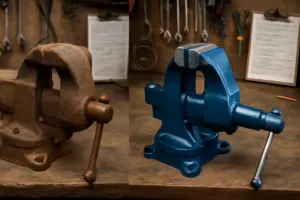

A Short History of the Bench Vise: From Blacksmith Leg Vise to Machinist Workhorse
There’s a twelve-dollar cast-iron vise sitting in my garage right now, painted industrial green, that I pulled from an estate sale years ago. When I brought it home, rust and decades of shop grime covered everything—I couldn’t make out the casting mark or the maker’s name for months of cleaning. Once I got it mounted and the mechanism working, something clicked: this tool had probably spent the better part of the 1940s clamped to a factory workbench, holding parts during wartime production. That single moment of recognition sent me down a rabbit hole. I wanted to understand why vises look the way they do, what chain of decisions and technological shifts shaped them, and how a piece of equipment from before I was born could still outmuscle most of what’s sold new today.
The story of the vise isn’t a simple one—it didn’t spring into existence fully formed. It’s an evolution spanning centuries, pushed forward by the actual demands of the work and whatever manufacturing capabilities existed at the time. Grasping that arc—where the leg vise originated, why the machinist’s vise looks nothing like its ancestor, what happened when American casting got undercut by overseas production—that context underpins everything we talk about here at The Rusty Bench. Let’s unpack it.
Before the Vise: The Screw Mechanism
Most people don’t realize just how old the screw really is. Archimedes wrote about screw theory way back in the third century BCE. Fast forward a couple hundred years and the Romans were already loading wine and oil presses with screw mechanisms—putting the technology to work in actual production. Medieval workshops were using screws to press paper. The concept was proven, mathematically understood, and already in use across multiple industries by the time the Middle Ages were winding down.
Translating that screw mechanism into a tool for gripping and securing metal during the work of shaping it—that was a separate challenge entirely. Blacksmiths and other metalworkers operated for centuries without needing screw vises. They relied on tongs to manage stock, hardies (wedge-shaped implements hammered into the anvil), and simple wedge-based clamping to keep work stationary while they hammered. When something needed to stay put while being filed or shaped, you drove a wedge under it. Crude? Maybe. But functional.
Here’s what matters: knowing an existing technology can solve a problem isn’t the same as actually applying it. You need specific circumstances to align—the type of workshop, the nature of the tasks being performed—before someone makes that conceptual leap and decides, “Let’s attach a screw to a clamp.” When those conditions finally fell into place, the results cascaded forward fast.
The Leg Vise: The First True Bench Vise
The leg vise (sometimes called a post vise) represents the original bench clamping tool, appearing in blacksmith shops around the 1600s or 1700s. The entire construction—jaws, screw, frame, everything—was forged individually by hand. No cast parts. No factory finishing. A blacksmith would take raw iron, heat it, and shape every component with hammer and anvil.
The brilliance of the leg vise lies right there in its nomenclature. Pull one apart and the design becomes obvious: it’s got a thick iron post extending down from the fixed jaw, running toward the ground (or settling onto a wooden mounting block). That vertical post carries the load. When you’re striking a clamped workpiece with a hammer, that post is what’s absorbing the energy and impact. The bench connection point doesn’t take the punishment—the leg does. For someone working with heated metal and striking tools, this isn’t just convenient. It’s survival. Skip this design element and your bench would splinter and fail within days from the constant pounding.
And here’s another unexpected feature: there’s zero spring mechanism. The moving jaw doesn’t spring-load in and out. The blacksmith manually opens and closes the movable jaw, and once work gets clamped, it remains locked. The lack of a spring mechanism removes an entire category of failure points—nothing fragile to fracture, nothing to wear out from repetitive opening and closing cycles. You can throw enormous force at the lever handle (that’s where leverage works in your favor) and achieve whatever clamping pressure the job demands without risking spring fatigue or mechanical damage.
Can you source a leg vise in today’s market? Absolutely. Blacksmiths depend on them. Bladesmithing practitioners actually prefer them. The brutal reality of hot-forging work—constant heat cycling, the violence of hammer impacts—will destroy a spring-loaded clamping tool within a season. But a vise forged by hand centuries ago? That design was engineered specifically to endure that exact punishment. I’ve personally seen leg vises operating in active forges that have been doing their job for two hundred years straight. Show me a mass-produced modern vise from a retail chain that’ll still be functional in 2224.
The Industrial Revolution and the Rise of the Machinist Vise
Here’s when the narrative takes an interesting turn. The 1800s brought machine shops into existence—and these were fundamentally different from blacksmith operations. These were spaces dedicated to precision metalworking: assembling engine components, manufacturing firearm assemblies, constructing textile equipment. The work was entirely different from blacksmithing. Metal wasn’t being heated and struck with hammers. Instead, workers were measuring tolerances, hand-filing surfaces, boring holes, fitting parts together with exactness and repeatability.
The leg vise became a liability in this environment. You couldn’t make rapid adjustments. The work surface stayed at one fixed height. Rotating a piece meant taking it out, repositioning it manually, and reclamping. The leg vise was built by and for blacksmiths, and it was getting in the way of what precision metalworkers actually needed.
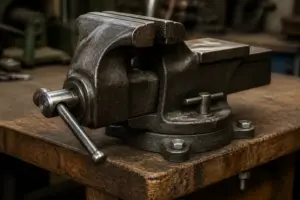
Vise engineering started shifting in response. The bench tool that emerged during this era—the swivel-mounted, spring-action, quick-acting vise we’d recognize today—solved machinist problems, not blacksmith ones. Instead of a leg transferring shock downward, you had a hefty cast-iron base capable of rotating. The moving jaw incorporated a spring to prevent it from dropping loose. The screw got redesigned for faster, more consistent changes in clamping distance. And casting replaced hand-forging as the production method.
The pivot from hand-forged to cast iron was transformative. Casting allowed for mass production. Tooling could be designed and replicated consistently from one part to the next. Measurements and specifications became standardized across an entire product line. Vises rolling out of a foundry looked identical to each other. Production costs dropped, which meant machine shops could outfit multiple benches instead of commissioning a blacksmith to make one custom piece.
The leg vise persisted in production—and still gets made today—but it’s categorized as blacksmithing equipment. The machinist’s vise, the cast-iron swivel-base model with the spring-loaded moving jaw, became the standard for industrial production work. That fundamental design spawned nearly every vise configuration in use in modern shops.
The American Golden Era: 1870s to 1960s
This era is when domestic vise manufacturing exploded. Foundries scattered across America were churning out vises by the thousands every year. Brand names like Prentiss, Reed Manufacturing, Wilton, Parker, and Columbian became embedded in the consciousness of every mechanic and factory worker. Walk into any machine shop, auto repair garage, or school woodshop during this period and you’d find American vises already occupying the bench. They weren’t specialty equipment—they were the default. Needing a vise meant buying American-made, and you weren’t second-guessing whether it would hold up.
Industrial demand drove both the quality and the precision of manufacturing. When World War I required a massive production ramp-up, foundries shifted into overdrive. Wartime factories needed parts—for aircraft, munitions, vehicles, everything—and that meant they needed clamping tools. Really good ones. Dependable ones. Foundries that had never considered making vises started learning casting. Quality standards got stricter. Specifications became formalized across the industry. The vises manufactured in American foundries throughout the 1940s and continuing into the postwar period reflected that pressure: they were engineered to work without failure, and constructed to endure for generations.
This explains the abundance of salvageable vises showing up at swap meets and auctions today. There’s an enormous installed base of American-manufactured vises still out there from those decades, and plenty of them remain mechanically viable—surface rust and accumulated grime might need attention, perhaps some component refurbishment, yet underneath they’re still sound. If you’re searching for an old vise to rehabilitate, the probability is quite high it originated from an American foundry between 1900 and 1970. That span covers the period when these instruments rolled off assembly lines by the millions.
I’ll direct you to our guide to identifying an old vise (link concept) in case you want to investigate specific manufacturers and date your findings. The granular details matter, sure, but what’s crucial for understanding this history is recognizing that American foundries controlled this market for nearly a century straight. They wrote the rulebook. They manufactured the tools that kept industrial America operating.
Post-War Decline and the Shift Overseas
Nothing lasts forever. Beginning in the 1960s, American vise manufacturing entered a long, slow contraction. Overseas casting operations—beginning with Taiwan, then spreading to the Chinese mainland—could deliver the same product for substantially less money. Shareholders and decision-makers began running the numbers and realized that competing on price against imports with production costs half of domestic was becoming untenable.
The majority of the venerable American vise manufacturers didn’t weather this transition as independent enterprises. Ownership transferred to larger corporations. Operations consolidated. Some brands vanished completely from the marketplace. What exists currently is fragmented: certain heritage brand names are still in circulation, but they’re now licensed labels applied to vises cast in foreign facilities, rather than products manufactured by American foundries. The difference isn’t trivial. A Wilton vise bearing a 1940s foundry marking is not the same instrument as a Wilton-branded vise manufactured in a Chinese foundry last month. Identical name. Completely different product.
The migration also brought consequences for precision and consistency of work. American foundries had spent decades honing their casting techniques, building skilled workforces, and establishing rigorous quality benchmarks. Nascent overseas operations were learning the trade from scratch. Some of their output was respectable. But much of it was… variable. Voids and porosity in the castings. Unfinished surfaces. Tools that appeared acceptable to the eye yet fell short in actual performance.
This reality explains why weekend mechanics and hobbyists actively seek out old American-manufactured vises. It transcends mere nostalgia. The foundry work and the manufacturing precision were objectively superior. A vise manufactured in 1950 frequently outperforms something made this week when all other factors match. And at flea market prices, it often costs you less money too.
The Vise Family Splits: Specialization
As time moved forward, metalworking and woodworking diverged into separate crafts rather than overlapping disciplines. That’s when vise designs started splintering into purpose-built variants. A single multipurpose vise gave way to specialized equipment tailored for specific applications.
The woodworking vise got developed with wooden clamping faces or leather-padded surfaces to guard against marring the workpiece. Installation often mounts flush along the front of the work surface (a front-mounted configuration), sometimes accompanied by a second vise at the bench’s end for stabilizing long pieces. A precision-ground machinist’s vise features surfaces finished to tight tolerances so it can bolt onto a milling machine table and position work to exact specifications. A drill press vise is compact and engineered to secure small workpieces during drilling operations. Pipe vises and chain vises grip round stock. The pin vise—a miniature setup—clamps tiny components for detailed hobbyist work.
Every design solves particular problems encountered in its intended application. It’s incorrect to rank one as superior and another as inferior—they’re distinct instruments for distinct jobs. My shop currently holds three separate vises, and I choose based on what the task requires. Specialization is the modern reality.
For an extended exploration of each vise category and its practical applications, we’ve published a detailed breakdown of vise types (link concept). This history focuses on the evolutionary path that brought us here. But understanding that vise designs fractured into specialized tools forms a significant chapter of the narrative. One design served everyone at first. The next generation refined it for machine work. Then the toolbox expanded, with each variant becoming better at its own specific purpose.
Where Things Stand Today
The current vise marketplace is fragmented in odd ways. There’s a segment producing restored versions of classic designs—consider the Wilton “bullet” model, still manufactured and actively sought because it performs exceptionally well and carries historical weight. The budget category is saturated with overseas imports: inexpensive vises that function adequately for casual projects but won’t accumulate decades of dependable use. Alongside that sits a community of enthusiasts and restoration practitioners—people in my camp—devoted to sourcing forgotten American vises, stripping away the deterioration, and returning them to productive work because using a tool manufactured with genuine craftsmanship carries meaning.
That mix represents the contemporary marketplace. It’s split among heritage appeal, utilitarian needs, and genuine mechanical value. Some customers prioritize convenience and buy new. Others hunt vintage equipment because superior function and lower cost point coincide. Others are attracted to the narrative embedded in these instruments.
The moment I finished rehabilitating that estate-sale vise—after clearing off the rust, repairing the internal screw mechanism, and adjusting the jaw alignment—I took a step back and simply observed it for a moment. Somewhere in the 1940s, some assembly-line worker mounted that exact casting onto a factory bench and commenced their shift. Aircraft components, maybe. Possibly ammunition components. Or perhaps they just fastened bolts all day long. Here I stand, seventy years afterward, gripping a piece of stock in the identical vise and executing my own fabrication. That tool persisted through multiple international conflicts, passed through different owners’ hands, languished unloved in a storage area, yet retained plenty of useful life remaining.
That’s my reasoning for continuously rehabilitating discarded vises rather than purchasing factory-fresh equivalents. Not purely financial calculation, though I appreciate a bargain. Rather, there’s something meaningful about continuity—utilizing an instrument manufactured correctly from the outset, subjected to serious use, and strong enough to transcend time. It represents a tangible link to everyone who came before and clamped their work in this identical tool. And functionally? It performs. That counts.
Curious to learn more about vises? Explore our resources on recognizing a vintage vise, cleaning and reconditioning a neglected vise, servicing the screw assembly, and proper vise installation. Now you understand their origins—let’s get into preserving them correctly.