
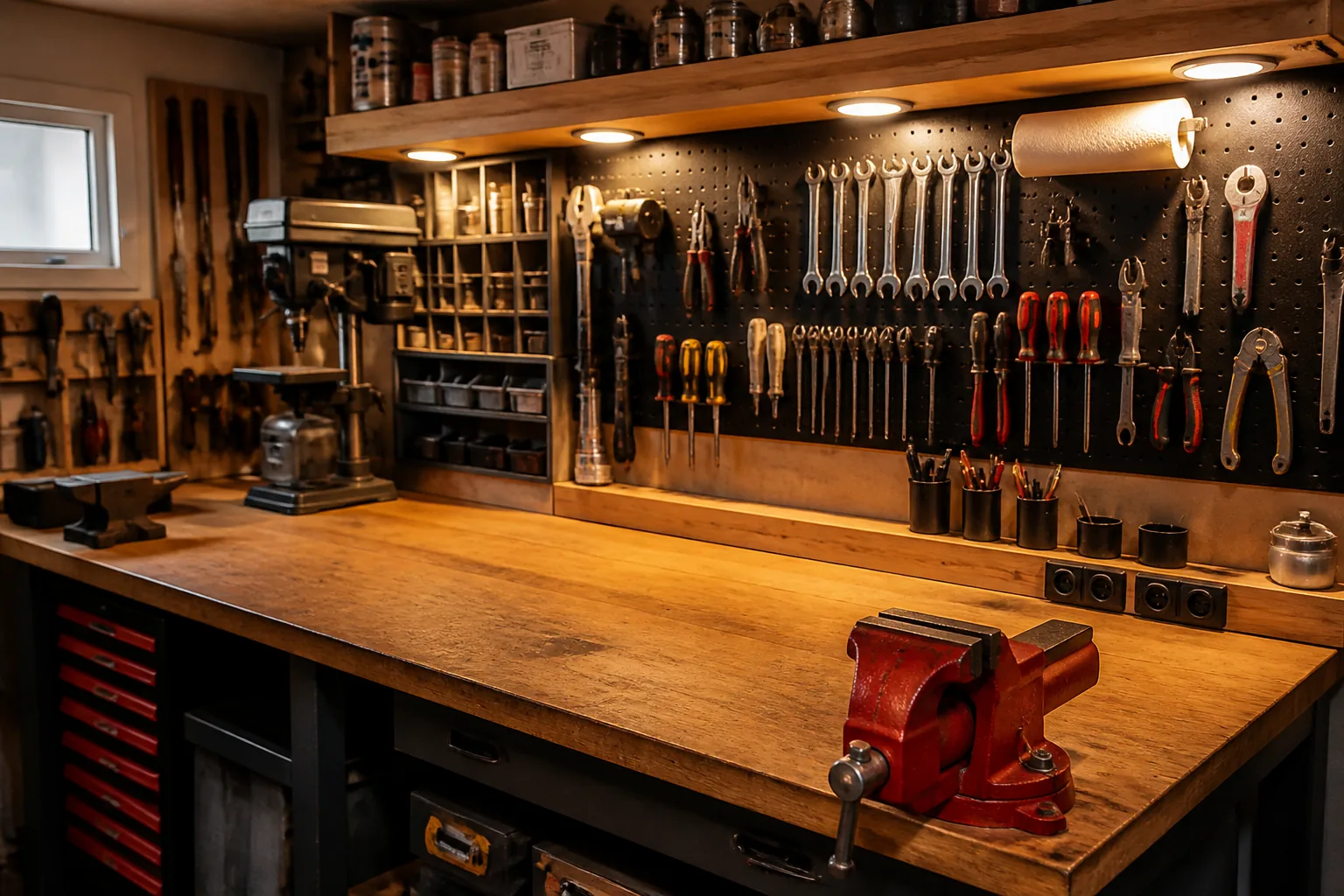
Every setting up first workshop guide I read when I was starting out had the same problem. They all assumed I had a spare 1,200-square-foot detached garage, a $5,000 budget, and a weekend free to install a dedicated 200-amp subpanel. I had a one-car garage I shared with a lawn mower, about $800 to my name, and no idea what I actually needed versus what YouTube was telling me I needed. I built my first real workspace anyway — and I made almost every mistake possible in the process.
This guide is the one I wish existed back then. It’s written for real people with real constraints: a tight budget, a shared or small space, and zero background in electrical work or construction. I’m not going to sell you a fantasy workshop. I’m going to walk you through the exact decisions I made — and the ones I’d make differently — so you can build something functional from day one and grow it over time.
I’ve been welding, grinding, and restoring tools in my garage in central Ohio for going on eleven years now. I’ve done this in a 280-square-foot single-car garage, later expanded into a two-car space when we moved. I’ve spent real money on real mistakes. What follows is hard-won, practical knowledge — not a spec sheet from a tool catalog.
Start With the Space You Have, Not the Space You Want
The single biggest mistake beginners make is waiting for a better space before they start. They imagine a future garage or a basement with high ceilings. Meanwhile, nothing gets built. Your first workshop doesn’t need to be ideal. It needs to exist.
Measure your actual available footprint first. Don’t measure the whole garage — measure the space you realistically control after parking, storage, and the water heater that your spouse will absolutely not let you move. In my first garage, I had roughly 10 feet by 14 feet of usable floor space. That sounds cramped, and it was. However, I built a welding cart, refinished two workbenches, and restored a dozen hand planes in that space over three years.
Ceiling height matters more than floor space in many ways. You need at least 8 feet to use a drill press comfortably or run any kind of overhead storage. Anything under 7.5 feet starts to feel genuinely dangerous when you’re moving long stock. Note your ceiling height before you plan anything else.
Plan Your Zones Before You Buy Anything
Divide your space mentally into zones: a primary workstation, a tool storage zone, a finishing or assembly area, and clear floor paths. You need at least 36 inches of clearance on all sides of any stationary machine — 42 inches is better. This isn’t just comfort. It’s a safety standard worth taking seriously.
I draw my shop layout on graph paper at 1 inch equals 1 foot before moving a single thing. It takes an hour and saves days of frustration. Sketch your doors, windows, outlets, and light fixtures first. Then place your major footprints. You’ll immediately see where the workflow breaks down. For example, I originally planned my grinder directly across from my welding table — then realized I’d be walking through my own sparks every time I moved between them.
[INTERNAL LINK: small workshop layout and space planning tips]
Your Workbench Is the Most Important Tool You’ll Ever Build
I mean this literally. Before you buy a single power tool, build a proper workbench. Everything else depends on it. A wobbly folding table covered in sawdust is not a workbench. It’s a liability.
For a first workshop, a bench that is 6 to 8 feet long, 24 to 30 inches deep, and between 34 and 36 inches tall will handle almost any task. Height is personal — stand up straight, let your arms hang, and measure from the floor to your knuckles. That’s your ideal bench height. Working too low destroys your back. I spent eight months working on a bench that was 31 inches tall before I rebuilt it at 34.5 inches. The difference was immediate and dramatic.
Build the top from 1.5-inch thick construction lumber laminated together — two layers of 2×8 or 2×10 glued and screwed. This gives you a surface that can take a beating, be planed flat when it warps, and won’t cost you more than $60 to $80 in materials. Avoid MDF for a primary work surface. It absorbs moisture, swells at the edges, and won’t hold dog holes or vise hardware reliably over time.
Vises and Clamping: Don’t Skip This
Mount a face vise on the left end of your bench if you’re right-handed — the right end if you’re left-handed. A 7-inch or 9-inch quick-release vise is the sweet spot for a first shop. Leg vises are fantastic, but they’re a second-shop upgrade. Spend your vise money on something with quick release. You’ll use it constantly.
Add four to six holdfast holes or dog holes along the front edge of your bench top. These cost nothing if you drill them yourself and turn a basic bench into a real workholding platform. In my experience, good workholding reduces project time by more than 20 percent and injury risk significantly more than that. A part that moves when you cut it is a part that will eventually cut you.
Essential Tools for a First Workshop — and What Can Wait
New workshop builders almost always buy too much too fast. They end up with a 10-inch sliding miter saw, a random orbit sander, and a brad nailer before they have a way to safely hold a piece of wood still. Buy capability in order of frequency of use, not in order of excitement.
Here’s how I’d sequence a first tool purchase list for a general-purpose shop — assuming a $1,000 to $1,500 starting budget. This covers both woodworking and basic metalworking tasks. Adjust for your specific focus, but the hierarchy holds.
- Workbench (build it): $60–$120 in materials
- Hand tools — chisels, squares, marking gauge, hand saw: $80–$150 used and restored
- Corded drill and a set of bits: $40–$80
- Circular saw or jigsaw: $60–$120
- Random orbit sander: $40–$70
- 4.5-inch angle grinder (for metalwork): $30–$60
- Bench vise (mounted to bench): $60–$150
- Clamps — at least 6 bar clamps and 6 C-clamps: $80–$140
That list tops out around $700 to $850. With the remaining $150 to $650 of your budget, build your electrical safety foundation and lighting before you add any stationary machines. I cannot stress this enough. A well-lit, safely wired shop with basic tools outperforms a poorly lit, overloaded shop with expensive machines every single time.
What Can Honestly Wait
Table saws, band saws, drill presses, lathes, and miter saws can all wait until your second phase of building — typically six to twelve months in, once you understand how you actually work. Too many beginners buy a table saw first because it seems essential. Specifically, it becomes essential once you’re regularly processing rough lumber in volume. Until then, a circular saw with a good straightedge guide does the same job.
The same logic applies to welding equipment. A flux-core welder is genuinely useful from day one if metalwork is your focus. However, a TIG setup, a plasma cutter, or an oxy-acetylene rig should wait until you’ve logged real hours with a basic MIG or flux-core machine and understand what the next tool actually solves for you.
Electrical — The Part Everyone Ignores Until Something Burns
I’m going to be direct here: undersized and overloaded electrical is the most dangerous and most common first-shop mistake. I ran a 15-amp circuit with two power strips in my first shop for nearly two years. I tripped breakers constantly, and once I ran a grinder and a shop vac simultaneously and saw arcing at the outlet. That was the day I finally called an electrician.
At minimum, your workshop needs two dedicated 20-amp, 120V circuits. One for your bench tools and one for dust collection or vacuums. If you’re adding a welder — even a small 120V flux-core unit — that machine needs its own dedicated circuit, period. Most 120V welders draw 20 amps at full load. Running one on a shared circuit with anything else is asking for a tripped breaker at best and a fire at worst.
When You Need 240V
Most hobbyist shops eventually want at least one 240V, 30-amp or 50-amp circuit. This handles a real MIG or stick welder, a table saw above 1.75 horsepower, or a serious dust collector. Plan for this before you finish your walls. Running a conduit chase now costs almost nothing. Running it after drywall is already up costs real money — I paid about $340 to have mine retrofitted, where it would have cost under $80 to rough in the conduit during my initial setup.
Always work with a licensed electrician for panel work and new circuit installation. This isn’t a liability disclaimer — it’s practical advice. Outlet and switch work is well within a capable DIYer’s range, especially in a detached garage or workshop. However, adding circuits at the panel, running new wire through finished walls, or installing a subpanel is where code compliance and safety genuinely require professional involvement. The permit and inspection also protect you if you ever sell the house.
As a result of my own electrical upgrade, my entire shop dynamic changed. I stopped working around power limitations and started working through projects.
Dust Collection and Air Quality — Protect Your Lungs First
Sawdust is not just messy — it’s a genuine health hazard, and fine wood dust is classified as a carcinogen. Metal grinding creates respirable particles and metal fumes that accumulate in your lungs over years of exposure. This isn’t scare-mongering. It’s the reason professional shops have serious ventilation systems and why you need at minimum a basic plan from day one.
For a first shop, your dust management stack should look like this, in order of priority. Start with a quality half-face respirator rated P100 for dust and organic vapor cartridges if you’re finishing. Wear it consistently. Cost: $30 to $60. Next, add a shop vacuum with a fine-dust filter (HEPA or equivalent) and connect it to your sander and router when possible. Cost: $60 to $150. Finally, if you’re doing serious volume woodworking, add a small single-stage dust collector — 1 to 1.5 HP is sufficient for a one-car shop. Cost: $150 to $300 new, often under $100 used.
Ventilation for Metalworking and Finishing
Welding fumes and finishing chemicals require ventilation beyond what a dust collector provides. For welding, you need fresh air movement across your work area — not just extraction directly above the arc. A box fan in an open window or door, positioned to move air across your body and away from your face, handles this in a small shop. That said, avoid pointing a fan directly at your weld puddle. You’ll blow away your shielding gas and get a terrible weld.
For finishing — painting, staining, applying varnish or lacquer — work with the garage door fully open, cross-ventilation from a rear window if possible, and your respirator on with organic vapor cartridges. Solvent vapors are both toxic and explosive at sufficient concentrations. This is one area where I will not suggest shortcuts. [INTERNAL LINK: shop ventilation and finishing safety]
Organization and Storage — Set It Up to Work the Way You Actually Work
The best shop organization system is the one you’ll actually maintain. I’ve tried pegboards, magnetic strips, shadow boards, and rolling tool carts. What actually works in my shop is probably not what works in yours, but the principles are universal.
Put the tools you use every day within arm’s reach of your bench. For me, that’s a wall-mounted magnetic strip for chisels and knives, a small shelf above the bench for measuring tools and marking gauges, and a single drawer below the bench for hardware I’m actively using. Everything else lives in a dedicated cabinet or bin — organized by category, not by project.
French cleat walls are legitimately excellent for small shops. A 4×8 sheet of 3/4-inch plywood ripped into strips at 45 degrees gives you a modular wall storage system for roughly $40 to $60 in materials. You can hang, rearrange, and add holders indefinitely without drilling new holes. I built mine in a Saturday afternoon and it transformed my wall space immediately. For example, I moved a router table that was taking up floor space onto the wall and recovered nearly 12 square feet of floor.
The Floor Is Not Storage
Repeat this as a mantra: the floor is not storage. Floor clutter is a tripping hazard, a fire hazard (sawdust buildup especially), and the fastest way to make a small shop feel unworkable. Keep a clear path — at minimum 36 inches wide — from your entry to every major machine. I sweep my floor at the end of every session, not just to keep it clean but because the act forces me to see what’s out of place and put it back.
[INTERNAL LINK: french cleat wall storage system build]
Common Mistakes in Setting Up a First Workshop — and How to Avoid Them
Mistake 1: Buying Everything Before Building Anything
I see this constantly. Someone gets excited, spends $2,000 on tools, and still has nowhere to put them. Build the bench first. Set up the basic electrical. Then buy tools as the work demands them. Tools purchased in anticipation of projects often sit unused while actually needed basics are missing.
Mistake 2: Ignoring Lighting Until It Becomes a Problem
Bad lighting causes bad work and causes accidents. A single incandescent bulb in a garage ceiling is not adequate for any workshop task. You need a minimum of 50 foot-candles of illumination at bench level — ideally closer to 70 to 100 foot-candles for detailed work. LED shop lights are inexpensive and plug into standard outlets. Budget $80 to $150 for two or three good fixtures and hang them before you do anything else. I wasted so many hours squinting under bad light in my first shop and called it a character-building experience. It wasn’t. It was just poor planning.
Mistake 3: Underestimating How Long Setup Actually Takes
A functional first shop takes three to six months to get right — not a weekend. The bench alone takes a weekend to build properly. Electrical work takes scheduling and time. Organization evolves with use. In my experience, the shops that end up working well are the ones where the builder accepted that setup is itself a long-term project, not a prerequisite that gets finished before the real work begins.
Mistake 4: Not Planning for Heat and Cold
If you live anywhere with real winters, an unheated garage shop will shut you down for months. Adhesives won’t cure below about 50°F. Finishing products fail in the cold. Your hands stop working before your brain does. A small propane or natural gas unit heater — typically 30,000 to 45,000 BTU for a one-car garage — costs $150 to $250 and runs about $15 to $30 per month during cold season depending on your climate. It is absolutely worth it. However, always ventilate when running any combustion heater in an enclosed space, and never use an open-flame heater in a shop where finishing is happening.
Mistake 5: Skipping a Fire Extinguisher
Mount a 5-pound ABC dry-chemical fire extinguisher within reach of your exit — not in the back corner, not under the bench. Near the door, always. Cost: $30 to $50. Keep it current (check the gauge monthly). If you’re welding or grinding, add a second one near that station. This is the cheapest insurance you’ll ever buy, and I say that as someone who once had a small welding fire in a pile of steel wool I forgot was next to my work area. It was out in seconds because the extinguisher was right there. Without it, that story ends differently.
Final Thoughts — Your First Workshop Doesn’t Have to Be Perfect
This setting up first workshop guide exists because too many people talk themselves out of starting. They wait for the right space, the right budget, or the right time. None of those things arrive on schedule. What actually works is starting with what you have, building the basics correctly, and improving steadily with every project.
Your first shop will be imperfect. Mine was. It had inadequate lighting, overloaded circuits, a bench that was too low, and a dust situation I preferred not to think about. However, I built real things in that shop. Skills developed. The mistakes taught me more than any guide could have. The point is that I started — and then I improved.
Here’s the sequence I’d give any beginner today, distilled to its simplest form. Measure and plan your space first. Build a solid workbench. Establish safe, adequate electrical and lighting. Add tools as projects demand them. Protect your lungs and your skin from day one. Keep the floor clear and the extinguisher close. Everything else is refinement.
The workshop you build doesn’t need to look like something from a magazine. It needs to be a place where you make things, learn things, and occasionally fix things you just broke. That’s the whole point. Get in there and start building it.