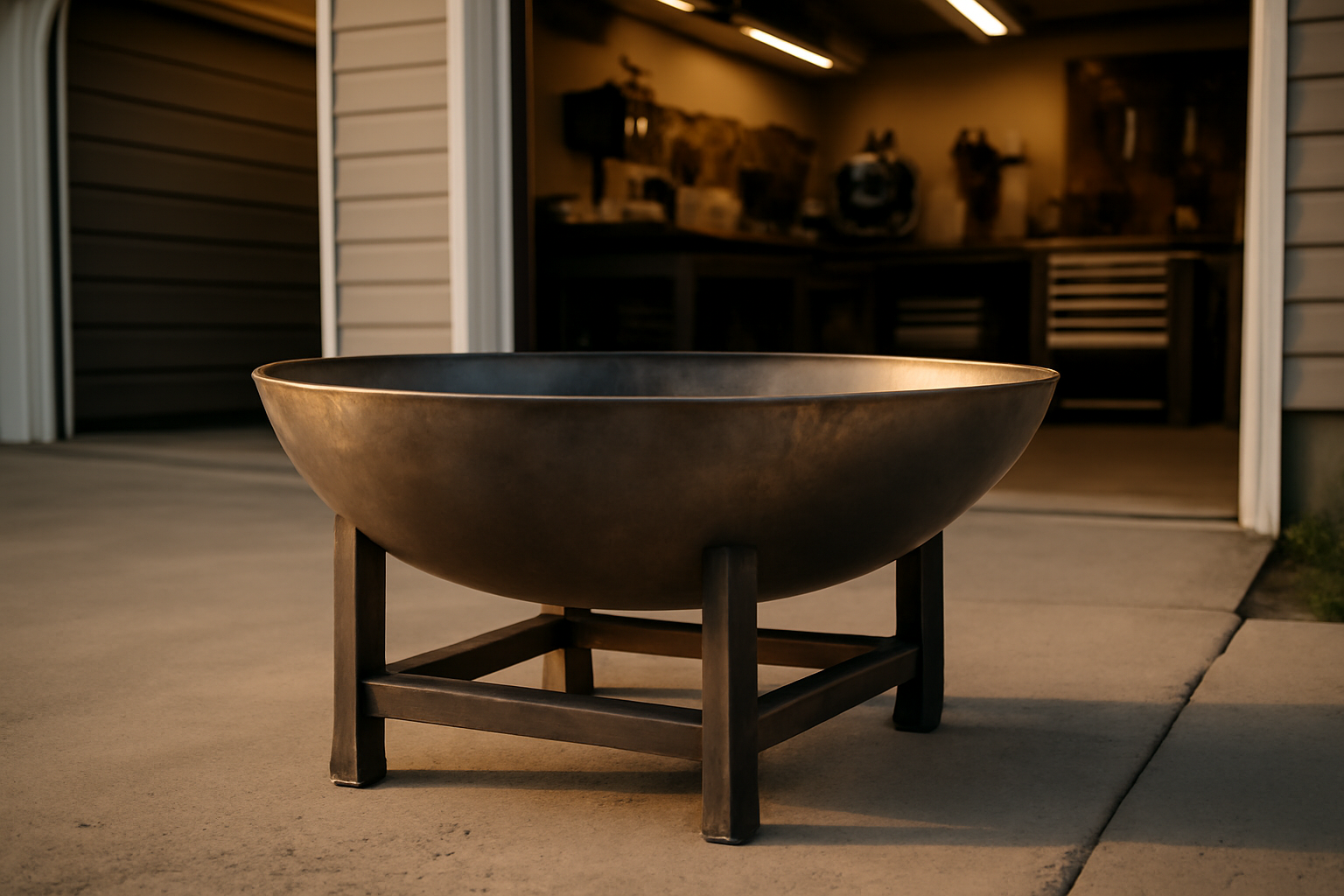
Steel fire pit warp prevention was not something I thought about when I built my first fire pit. I figured steel was steel — weld it up, set it in the yard, light a fire. Twelve years of garage shop work later, I know exactly how wrong that assumption was. That first pit looked great on a Saturday afternoon. By the following spring, the bottom plate had bowed up nearly an inch in the center, the legs were rocking, and the whole thing looked like a sad metal salad bowl.
I built a second one. That one warped too, though slower. That failure taught me something the first one did not — I had the right instinct but the wrong execution. It was not until my third build that everything clicked. That pit is still sitting on my back patio, perfectly flat, after four winters and hundreds of fires. This post is everything I figured out across those three builds, including the mistakes I am not proud of.
If you are planning to weld or fabricate your own steel fire pit, this guide is for you. I will walk through material selection, design geometry, welding technique, and a product I genuinely use and recommend. No fluff — just what actually works in a real garage shop.
Why Steel Warps in the First Place
Before you can prevent warping, you need to understand what causes it. Steel expands when it heats up and contracts when it cools. That is basic thermodynamics. However, the problem with fire pits specifically is that the heat is uneven. The bottom center of the bowl gets the most direct heat. The outer edges and the legs stay comparatively cooler. As a result, you get differential expansion — one part of the steel wants to grow while the adjacent part resists it.
That internal stress has to go somewhere. In a flat plate, it goes into a bow. In a fabricated box shape, it goes into twisted seams and racked corners. The thinner the steel and the larger the unsupported span, the worse the warp. My first pit used 10-gauge sheet steel for the bottom — about 0.135 inches thick. That was my first mistake. It looked plenty beefy on the welding table. Under fire load, it acted like a potato chip.
Welding itself also introduces residual stress. Every weld bead contracts as it cools, pulling the base metal toward it. If you run a long, continuous bead on a large flat plate without a proper sequence, you are pre-loading that plate with stress before the first fire ever burns. The heat from fires just releases what was already there. Understanding both of these stress sources — thermal cycling and weld residual stress — is the foundation of everything else in this post.
Material Selection and Plate Thickness for Steel Fire Pit Warp Prevention
After two failures, I went back to basics on material. For the fire bowl or firebox bottom, I now use a minimum of 3/16-inch plate steel — that is about 0.1875 inches, or roughly 7-gauge equivalent. In practice, I prefer 1/4-inch plate for any span wider than 18 inches. Yes, it costs more and weighs more. However, the increased rigidity dramatically reduces thermal deflection. The extra mass also acts as a heat sink, distributing temperature more evenly across the surface.
For the walls and sides, 10-gauge or 12-gauge is fine. The sidewalls do not bear the same direct radiant heat from the fire grate, and they are supported by the corner welds and any angle iron reinforcement you add. Specifically, I add a continuous 1.5-inch by 1.5-inch angle iron frame around the perimeter of the bottom plate on every build now. That single addition made more difference than any other change I made between my second and third pits.
On the steel type: plain A36 mild steel is what most of us use, and it is perfectly adequate. That said, if you can source AR400 or even just hot-rolled plate instead of cold-rolled, you will get slightly better performance under repeated thermal cycling. I learned this the hard way after my second pit — cold-rolled steel has more internal stress from the rolling process itself, which makes it more prone to movement when heat is applied. Hot-rolled is not glamorous, but it is more stable for fire applications.
A Note on Corten Steel
Corten, or weathering steel, comes up a lot in fire pit conversations. It develops a stable rust patina that protects the underlying metal. In my experience, it is a great choice aesthetically and holds up well to weather. However, it is not magic against warping — you still need the same plate thickness and reinforcement strategy. Corten also costs roughly 30 to 50 percent more than A36 at most steel suppliers. For most garage builders, A36 with a proper design beats expensive Corten with a poor one every time.
Design Geometry: The Changes That Actually Fixed My Warp Problem
The geometry of your fire pit design matters as much as the material. My first two pits were simple box designs — four walls welded to a flat bottom plate, four legs, done. Clean and easy to build. However, a large unsupported flat plate is about the worst geometry you can choose for thermal stability. Think about how engineers handle large steel structures — they use gussets, ribs, and flanges to add rigidity without adding weight. The same principle applies here.
On my third build, I made three geometric changes. First, I kept the bottom plate span under 24 inches in any direction. If you want a bigger pit, break the bottom into sections divided by a welded rib of 1/4-inch flat bar running across the center. Second, I added that perimeter angle iron frame I mentioned earlier — it acts like a flange and resists the upward bow almost completely. Third, I added four 1/4-inch gussets at the corners where the legs meet the frame. Those corners are stress concentration points, and the gussets spread that load.
Drain holes matter too, though not for warping directly. A 1/2-inch hole drilled or punched every 8 to 12 inches across the bottom plate lets water drain after rain. Standing water accelerates corrosion, which thins the plate, which makes future warping worse. My current pit has seven 1/2-inch drain holes, and I angle the bottom plate very slightly — maybe 1 to 2 degrees — toward one corner so water does not pool. Small detail, big long-term difference.
Welding Sequence and Technique to Minimize Distortion
This is where most self-taught welders — myself included, early on — get into trouble. AWS D1.1, the Structural Welding Code, dedicates entire sections to distortion control for a reason. You do not need to read the full spec, but the core principle is simple: weld in a sequence that balances heat input around the neutral axis of the assembly. In plain terms, do not weld one side completely before starting the other side.
For a rectangular fire pit, I use a skip-weld sequence. I tack all four corners first, then run 2-inch stitch welds, alternating sides and working from the center outward on each pass. I let the steel cool to the point where I can comfortably touch the area near the weld between passes — roughly 300 to 400 degrees Fahrenheit by feel, or I use a cheap infrared thermometer from the shop. Specifically, I never run more than about 6 inches of continuous bead on the bottom plate attachment without moving to the opposite side.
Backstep welding is another technique worth knowing. Instead of welding left to right continuously, you weld short segments in the opposite direction of your overall travel — so the bead deposits go right to left, but your position moves left to right overall. This distributes the heat more evenly and reduces the “pulling” effect that causes plate distortion. I started using backstep technique on the bottom plate welds on my third build, and it made a noticeable difference in how flat the finished plate sat on my layout table after cooling.
Pre-Heating and Post-Weld Cooling
If you are welding in a cold garage in winter — which I do, because that is when garage projects happen — pre-heat your steel. For 1/4-inch plate, I bring the base metal up to around 150 to 200 degrees Fahrenheit with a propane torch before striking an arc. This reduces the thermal gradient between the weld zone and the surrounding metal, which directly reduces distortion. Let the finished weldment cool slowly and evenly. Do not quench it with water or drag it outside into the cold. Slow, even cooling allows internal stresses to relax rather than lock in.
The Gas Burner Insert I Use Instead of a Raw Wood Fire
About two years ago, I built a fire table rather than a traditional wood-burning pit. My wife wanted something we could actually sit around without moving chairs every ten minutes to avoid smoke. That project introduced me to gas burner inserts, and I have not gone back. If you are building a gas fire table or converting an existing pit, the insert you choose has a direct impact on how much thermal stress your steel frame takes on.
The insert I use and genuinely recommend is the Stanbroil 48 x 14 Inch Rectangle Drop-in Fire Pit H-Burner Pan. It is built from 304 stainless steel, which handles thermal cycling far better than plain mild steel — stainless has better oxidation resistance at elevated temperatures. The H-burner design spreads flame across the full 48-inch length evenly, which actually helps reduce hot spots compared to a single-point burner. It is rated at 185,000 BTU max, which is more than enough for any outdoor table application. I run mine well below max and still get an impressive flame height.
The drop-in design means I built my table frame to accept it as a component — the burner pan sits in a framed opening, and the surrounding steel frame never gets direct flame contact. This is a significant advantage from a warp prevention standpoint. The steel table frame stays cool while the stainless insert handles all the thermal work. Installation was straightforward — I connected it to a 20-pound propane tank with a standard regulator and hose, total setup time about an hour. The build quality on this unit is solid. At the price point, it would cost me more in materials and time to fabricate something comparable from scratch.
Budget Alternative for Wood-Burning Builds
If you are building a traditional wood-burning pit rather than a gas table, a drop-in ring insert is a smart move. The OUSHENG Fire Pit Ring, 33-inch outer diameter with a 30-inch inner diameter, is a solid budget-friendly option. You build your outer structure from whatever material you prefer — stone, concrete block, or welded steel — and drop this ring in as the actual fire containment liner. The ring takes the direct abuse from wood fires, and your outer structure stays protected. It is a good way to protect a decorative steel frame from the worst of the thermal cycling.
When to Call It: Honest Limits of the DIY Approach
I am a self-taught welder. I am not a licensed structural engineer or a certified AWS welder, and I want to be straight with you about what that means. The techniques in this post work for backyard fire pits — decorative, personal-use structures that you own and maintain. However, if you are building something for a commercial space, a rental property, or as a product to sell, you need to work within different standards. OSHA, local fire codes, and potentially NFPA 211 or your municipality’s open burning regulations may all apply.
Gas fire applications specifically require attention to manufacturer installation guidelines, proper regulator sizing, and in some jurisdictions, inspection or permitting. The Stanbroil unit I referenced includes manufacturer instructions — read them fully before installation. Do not improvise gas line connections or attempt to exceed the rated BTU input for the regulator you are using. That is a hard line, not a suggestion.
On the fabrication side: if your welds are not consistently achieving full fusion on 1/4-inch plate, this project will teach you to weld — but it will also give you a fire pit that may crack at the seams over time. Practice on scrap first. A few hours on practice plate before starting the actual build is time well spent. In my experience, most garage builders underestimate how much heat 1/4-inch plate needs to achieve good penetration. Run your settings hotter than you think you need and test on scrap before committing to the workpiece.
Final Thoughts on Steel Fire Pit Warp Prevention
Steel fire pit warp prevention comes down to three things: the right material thickness, a geometry that distributes thermal stress, and a welding sequence that does not pre-load your steel before the first fire. Get all three right and your pit will last for years. Get one wrong and you will be where I was after my first two builds — grinding off welds and starting over.
Here is the short version of everything I covered:
- Use 3/16-inch minimum plate, 1/4-inch preferred, for any span over 18 inches
- Frame the bottom plate perimeter with 1.5-inch angle iron on every build
- Keep unsupported spans under 24 inches or add a center rib
- Use skip-weld and backstep technique — never run long continuous beads on flat plate
- Pre-heat in cold conditions, cool slowly after welding
- Consider a drop-in insert — gas or wood-burning — to protect your frame from direct heat
My third fire pit cost me about $140 in steel, two weekends of shop time, and a lot of lessons from the two that came before it. It has not moved a millimeter. That is the kind of result that makes the whole process worth it. Build it right the first time, or be willing to build it twice. Either way, you will learn something.
This post contains affiliate links. As an Amazon Associate, I earn from qualifying purchases at no extra cost to you.