
Most woodworkers treat card scrapers as optional luxury tools, but they’re actually solving a problem sandpaper can’t—and once you understand the difference, you’ll stop wasting time chasing tear-out on figured wood. I spent years convinced sandpaper was the complete answer until a stubborn piece of curly walnut forced me to try something different. A $6 card scraper handled what three different sandpaper grits couldn’t, and that single project rewired how I approach surface prep. The real distinction isn’t about which tool is universally superior—it’s about recognizing what each one handles best and where the other one will let you down.
How I Originally Dismissed Card Scrapers
During my early garage years—probably my second or third year—card scrapers struck me as woodworking gatekeeping dressed up as a tool. Sandpaper made intuitive sense: grab different grits, work parallel to the grain direction, end up with smooth wood. It’s a straightforward process without much room for user error if you’re willing to take your time. But card scrapers? Rolling a burr onto the edge with a burnisher, learning the correct angle, maintaining the edge constantly—all of that seemed needlessly fussy when sandpaper already did the job.
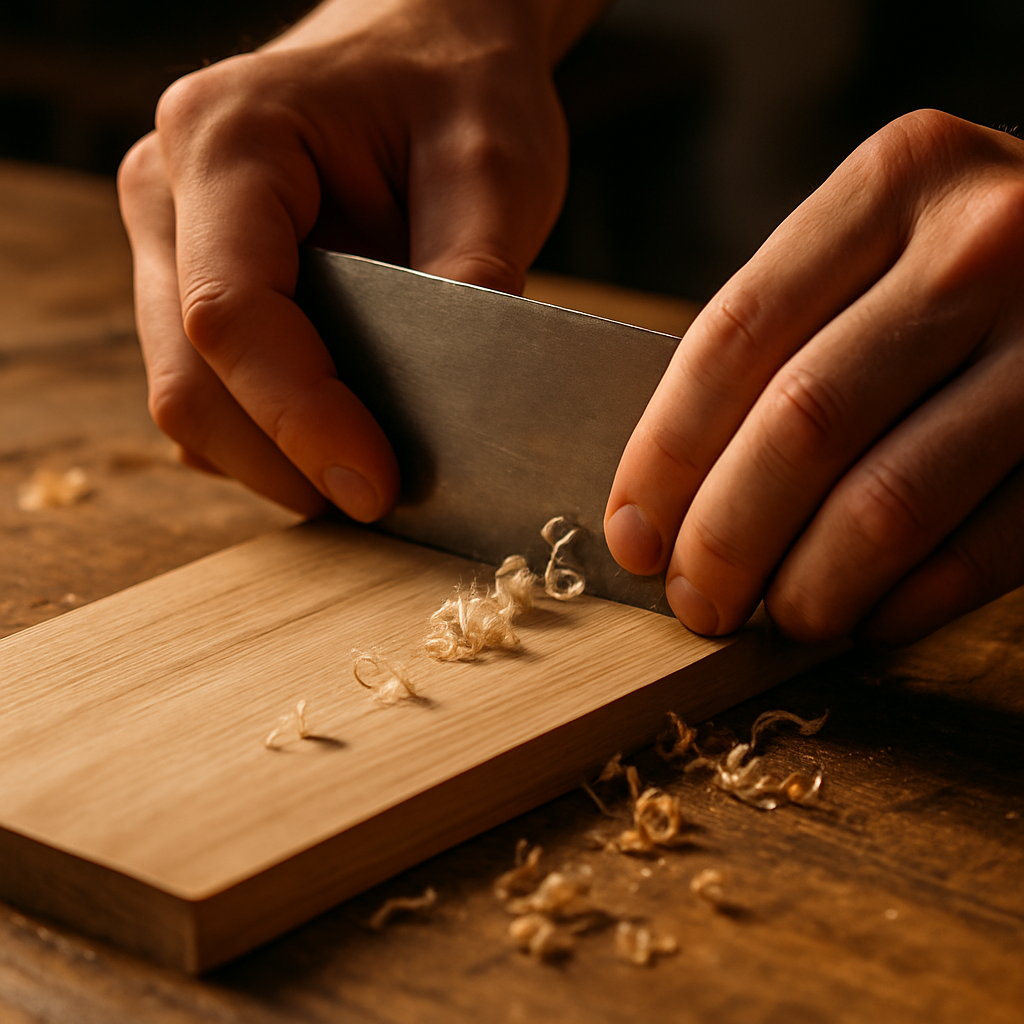
Reality hit when I encountered a walnut tabletop with grain that shifted and twisted every direction. No matter what sequence of grits I moved through—starting coarse and working finer—sandpaper kept tearing the wood fibers. I was essentially spinning my wheels, trying different strategies instead of confronting the fact that my tool selection was the bottleneck. Someone at the local tool library let me borrow a Flexcut scraper, and within two minutes of actual scraping time, the surface transformed from rough and damaged to smooth and uniform.
That’s when I realized this wasn’t witchcraft—just a fundamentally different mechanism for smoothing wood. Both approaches work; they’re just not substitutes for one another.
Understanding Sandpaper’s Mechanics
Sandpaper consists of abrasive particles bonded to a substrate—typically paper or fabric. The action you get is material removal through friction and grinding. This principle has held up so well for so long because it genuinely works across a broad range of applications. The number designation (80, 150, 220, etc.) indicates particle size: larger particles at lower numbers = faster stock removal; finer particles at higher numbers = smoother intermediate results.
In my own work, sandpaper dominates several categories of tasks. Taking off old stain, varnish, or paint? Sandpaper is my starting point—throw 120-grit on an orbital sander and demolish that finish faster than any other single tool I have access to. When I’m dealing with minor unevenness or working across multiple grain directions without worrying about the consequences, sandpaper’s forgiving nature makes it the obvious choice because the cutting action distributes randomly across countless particle points. And practically speaking, maintenance is nonexistent—when it’s worn out, buy a replacement sheet.
The issue nobody really talks about, though, is this: sandpaper doesn’t produce a genuinely clean surface the way a sharp edge does. The mechanism is erosion—crushing and grinding fibers rather than shearing them. When wood grain refuses to cooperate and runs in conflicting directions, this creates splinters and chunks torn from the surface. Push toward finer grits hoping to minimize damage, and the abrasion rate plummets; you’re suddenly investing serious time with 320-grit to undo what a scraper could resolve in a handful of minutes.
How a Card Scraper Operates Differently
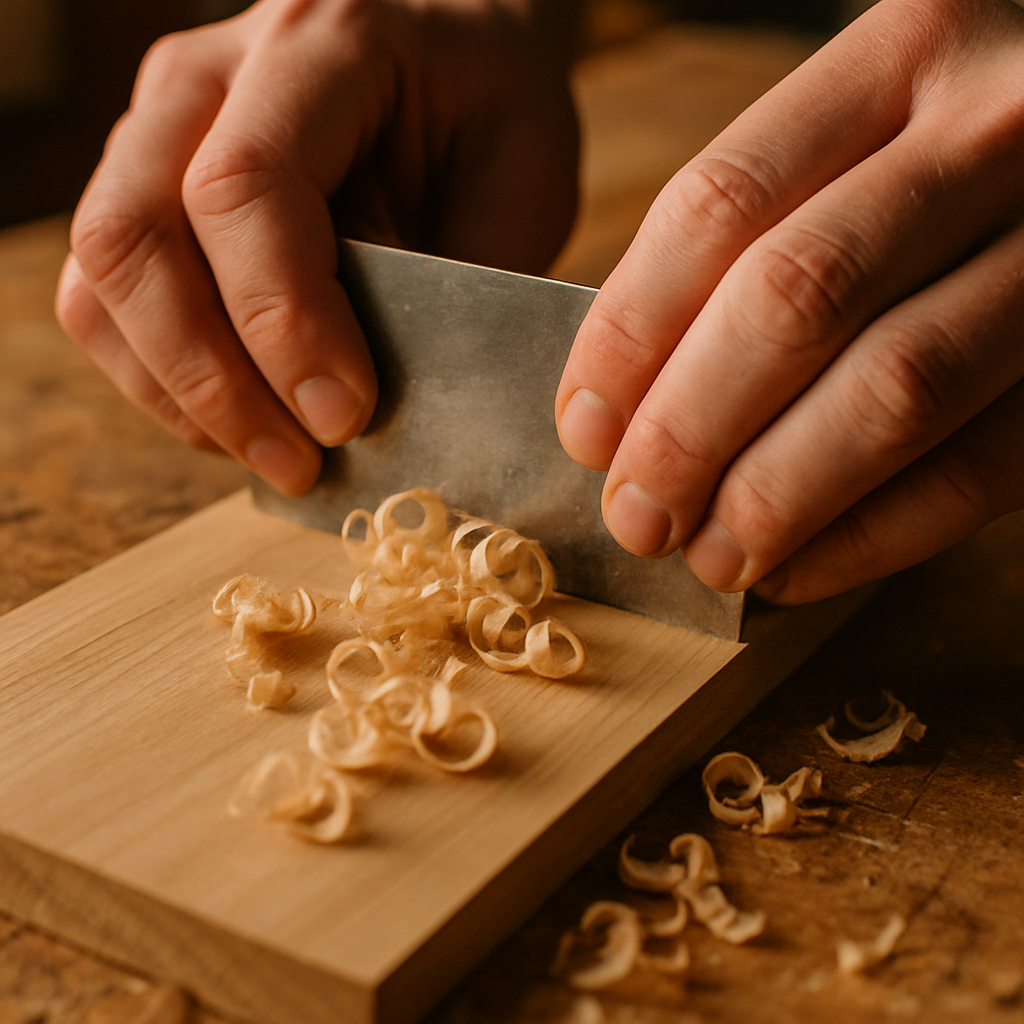
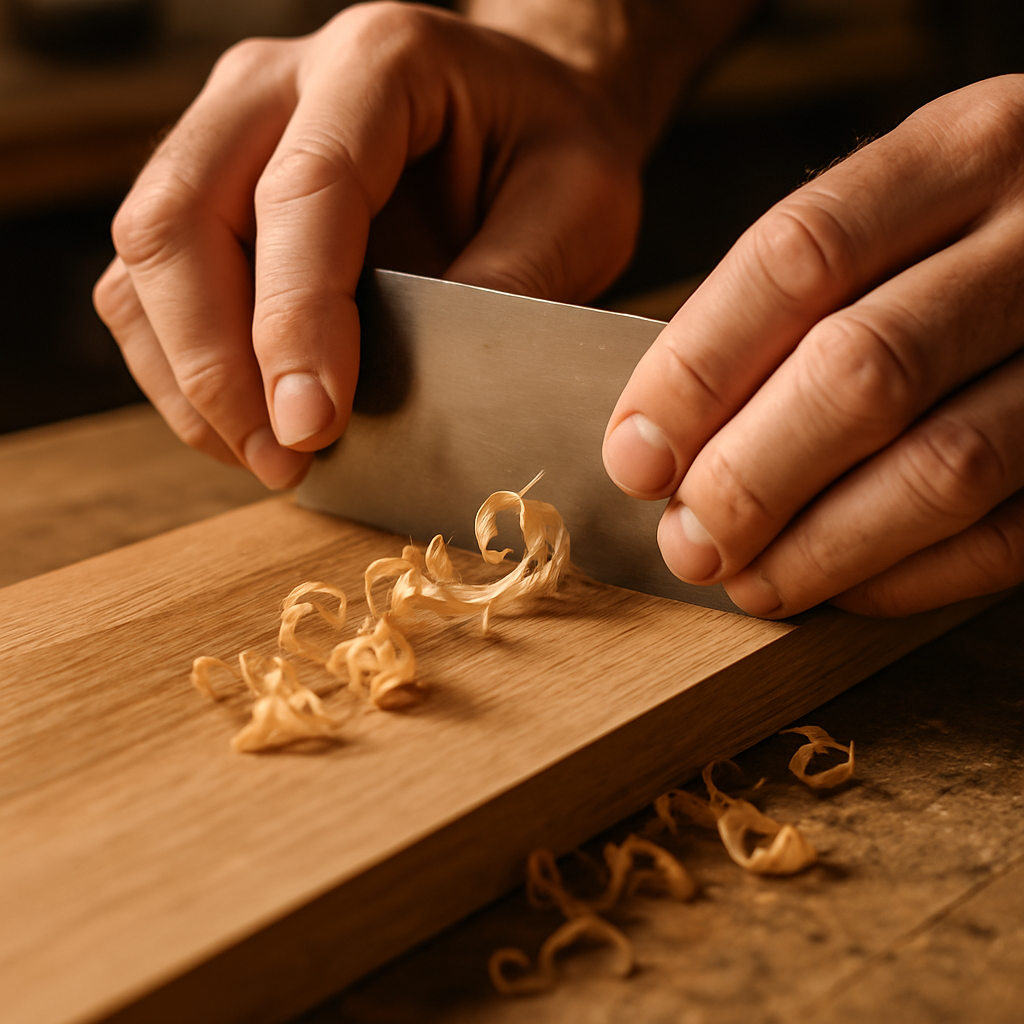
A card scraper is essentially a slim, stiff sheet of hardened steel—typically rectangular—with a microscopically sharp edge hook (called the burr) rolled onto one side. Angling it around 45 degrees and pushing it forward across the wood surface causes that burr edge to cut the wood fibers with a slicing motion rather than grinding them away. The action resembles planing more closely than sanding, yet it succeeds on figured grain that would jam a hand plane completely.
My personal learning curve with burnishing got rocky initially. I attempted to create my own burr and ended up with an unusable edge that did nothing. The angle seemed off, the pressure felt awkward, and the result was a totally dull edge. Digging into some reference videos revealed the critical point: you work from the flat surface down toward the edge, not in reverse. Once I got that mechanics right, scrapers suddenly performed—they peel off tissue-thin shavings and deliver a work-ready surface without sandpaper bridging steps.
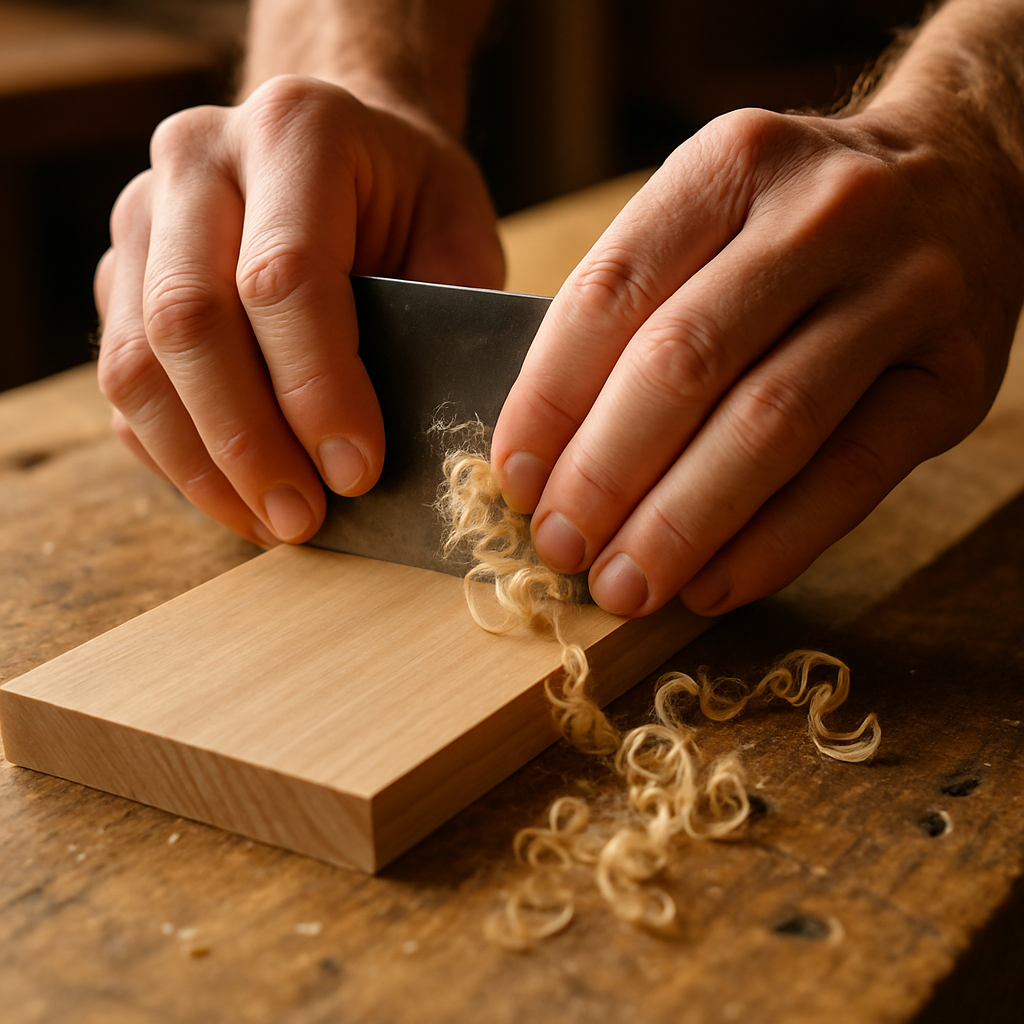
However, card scrapers come with limitations that matter. They excel on tricky grain, cross-grain situations, and final stages where surface perfection is the priority. But stripping heavy material? Scrapers move too slowly for that job. The edge stays functional for roughly 15 to 20 minutes of continuous work; past that, re-burnishing becomes necessary. And if you’re removing finish or tackling heavy-duty stock removal, sandpaper simply covers ground faster and demands less attention.
Deciding Which Tool for Which Task
My own shop practice breaks down this way:
Where sandpaper gets the job:
- Removing old coatings and finishes (using 80 to 120 grit in an orbital sander configuration)
- Reducing elevation differences that require significant material loss
- Pre-finish smoothing on straightforward-grain softwood species
- Projects where surface perfection isn’t a concern (experimental builds, garage fixtures)
Where scrapers outperform sandpaper:
- Terminal surface refinement on ornamental hardwoods (curly maple, walnut, ash with wild figures)
- Clearing away adhesive residue without damaging surrounding surfaces
- Evening out a surface when perpendicular sanding would generate splintering
- Reaching a stain-ready surface without intermediate sanding passes
The distinction in surface quality emerges immediately once you set examples beside each other. Sandpaper, even at 220-grit, deposits microscopic linear marks everywhere. A competently scraped surface—particularly one worked on problematic grain—bounces light back uniformly. When stain or topcoat goes on afterward, this distinction registers instantly. Those minuscule scratches broadcast through finish like tire tracks on a wet road.
I discovered this through painful experience when I prepped a walnut dresser with nothing but sandpaper and then stained it—the chatoyant grain became so visually chaotic with highlights and shadows that I invested days trying to sand back the damage and achieve visual harmony. Had I run that walnut through a scraper after initial sanding, the figured surface would have read as coherent and luminous underneath the stain.
Investment and the Learning Curve Question
Purchasing a usable card scraper runs $5 to $15. If you want a dedicated burnisher, expect another $10 to $30, though honestly a round object—a screwdriver shaft works perfectly—can substitute for the purpose of rolling the burr. Sandpaper sheets range from $2 to $5 per unit, and larger projects consume multiple sheets without question. Economics lean toward scrapers when you calculate spending across multiple projects over time.
The learning investment is manageable but genuine. Mastering burr creation and maintenance typically requires about 15 minutes of instruction followed by 20 minutes of hands-on repetition before you’re getting consistent, functional results. That time expenditure pays genuine dividends if finishing high-quality work is part of your regular output. For people constructing basic garage-grade pieces, the mastery curve probably isn’t justified.
My Actual Guidance on This Question
Across a dozen years of working out of a two-car garage space, I maintain both a card scraper and a collection of sandpaper, and both get regular rotation. They’re not antagonists—they’re complementary implements that perform better than the other for specific applications.
For beginners, sandpaper is the logical entry point. The learning curve is flat and the margin for user error is forgiving. However, if you encounter yourself repeatedly battling tear-out on figured wood, or chasing a surface refinement that sandpaper alone refuses to deliver, allocating resources to an inexpensive scraper and learning its upkeep is transformative for figured hardwood finishing.
The superior result emerges from pairing both: start with sandpaper for surface leveling and finish removal, then employ a scraper as your closing move for detail zones and tricky grain. Success looks like running your palm over finished wood and sensing only smoothness, and observing light reflection that’s uniform regardless of how the grain actually runs beneath your hand.
So card scraper versus sandpaper? Not an either-or selection. It’s about recognizing what each mechanism accomplishes and sequencing them based on the specific wood situation occupying your bench.