
At 3/16 of an inch, the deflection on my first attempt at a work surface was enough to wreck every square frame I tried to assemble on top of it. That gap—barely visible to the naked eye—proved costly in time and materials before I scrapped the design entirely and started over with proper dimensioning and a rigid base structure.
Retail welding tables run between $400 and $800 according to most supplier catalogs. That number holds up if you’re ordering from an established vendor. When I sourced raw steel and fabricated the whole assembly myself, my invoice totaled $187 for tube stock, flat plate, rolling casters, and fasteners combined. After more than thirty-six months of daily operation in my two-car garage, the frame has yet to display any measurable flex or settling.
Everything you need to replicate this build—material specs, exact dimensions, cutting sequences, and the setbacks I encountered—appears in what follows. Grab something to write with. The specifics matter here, and they’re all included.
Why Most Garage Welding Tables Fail
Browse through a few home shops, and you’ll spot handmade welding tables that have seen better days. The structural issue is rarely inadequate welds. The culprit is almost always undersized frame material. Hobbyists often grab whatever leftover tube sits in their scrap pile—typically 16-gauge or 1-inch thin-wall sections—then become puzzled when the whole setup rocks during vise operation or warps after exposure to extended heat cycles.
Inability to compensate for out-of-level conditions ranks second on the failure list. A table without adjustment capability becomes a liability once serious fabrication begins. When you’re establishing square on a structural assembly or positioning dual brackets for alignment, even 1/16 inch of height difference across the work area compromises precision. I discovered this painful reality partway through my original attempt, which ended in complete deconstruction and a fourteen-hour restart after realizing the flaws.
Third among common mistakes is choosing inadequate surface material. Welding directly onto thin stock leads to inevitable warping and distortion. The working surface demands sufficient mass to absorb thermal energy without deformation. In my experience, 3/8-inch hot-rolled plate represents the bare minimum for general use. For applications involving heavy clamping and fixture mounting, stepping up to 1/2 inch proves worthwhile. The additional weight pays dividends throughout the table’s service life.
My DIY Welding Table Build Plans — The Full Design
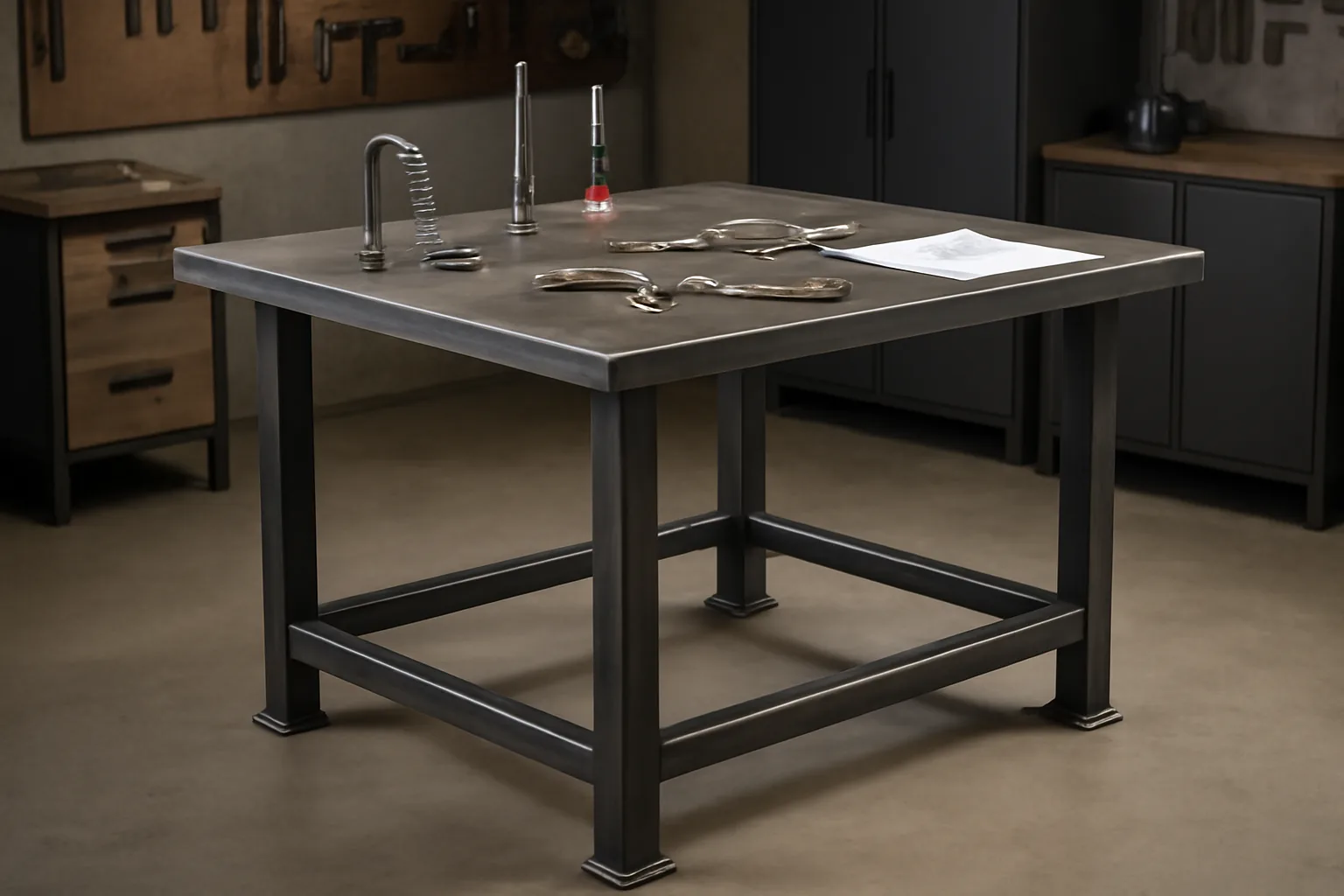
The dimensions I settled on—48 inches across the width and 36 inches fore-to-aft—create a finished working height of 34 inches from floor level. This measurement aligns with standard kitchen counter dimensions, positioning the fabrication surface at comfortable standing level for a person of average height around 5’10”. Your own proportions might call for raising or lowering this figure; the calculation remains simple and flexible.
Construction throughout relies exclusively on 2×2 mild steel square tube featuring 1/8-inch wall stock—the equivalent of 11-gauge material. This thickness strikes the proper balance for a surface that will endure clamping hardware, bench vises, and stacked plate inventory. Thinner-gauge sections experience creep and racking when subjected to prolonged clamping loads. Going thicker adds expense without delivering measurable benefit for most home builders.
The foundation consists of four vertical supports, dual lower bracing members, four perimeter rails at the top, and two internal bracing webs. The resulting configuration creates a reinforced box structure topped by a working platform, with a lower storage tier positioned at the 12-inch mark. Every connection runs a full fillet bead; I avoided mitered joints throughout. Though miters present a cleaner visual appearance on tube assemblies, they require additional fitting time without providing structural advantages relevant to this particular application.
Full Cut List
- Vertical Supports (4 pieces): 2″ x 2″ x 1/8″ square tube — 32.5″ length (incorporates allowance for 1/8″ caster mounting pad and 1.5″ upper rail integration)
- Upper Perimeter — Long Direction (2 pieces): 2″ x 2″ x 1/8″ square tube — 48″ length
- Upper Perimeter — Short Direction (2 pieces): 2″ x 2″ x 1/8″ square tube — 32″ length (designed to nest within the longer members, establishing true 36″ dimension)
- Interior Support Webs (2 pieces): 2″ x 2″ x 1/8″ square tube — 32″ length (positioned at the top-frame elevation, spaced symmetrically 16 inches from opposite ends)
- Storage Tier — Long Direction (2 pieces): 2″ x 2″ x 1/8″ square tube — 44″ length
- Storage Tier — Short Direction (2 pieces): 2″ x 2″ x 1/8″ square tube — 32″ length
- Working Platform: 3/8″ hot-rolled flat plate — 48″ x 36″ footprint (procured directly through a local steel distributor)
- Storage Platform: 10-gauge perforated sheet metal — 44″ x 32″ footprint (open design permits fall-through collection of debris and spatter)
Approximately 26 linear feet of 2×2 tubing comprises the complete frame assembly. By sourcing material in 72-inch blanks, I achieved efficient nesting during layout and significantly reduced scrap generation. Further details about sourcing appear in the following section.
The Square Tube That Actually Stays Square Under Heat
Frame members in a welding platform must withstand cyclical thermal shock and mechanical loading without yielding or distorting—inferior tube stock will begin twisting on you, turning your work surface into a year-long chasing of adjustments. Selecting appropriate steel tubing delivers the dimensional stability required for consistent, accurate fabrication work throughout the table’s operational span.
What works
- At 1/8″ thickness, the material absorbs thermal cycling without buckling, yet remains light enough to maneuver and position without requiring equipment assistance in your shop.
- Mild steel at this specification exhibits surprisingly clean surface finish straight from the mill—minimal oxide remnants or surface contaminants appear when you begin sectioning.
- A 2-inch square cross-section furnishes adequate bearing width for fixture mounting and work-holding apparatus without creating geometrical complications during assembly.
What doesn’t
- Parcels shipped via courier services frequently sustain damage in transit—dents and kinks appear with regularity—so thorough visual inspection upon delivery prevents lengthy warranty disputes later on.
- Heavy mill oxide coating necessitates abrasive preparation prior to joining operations, consuming an additional hour of grinding or wire-brush work to achieve sound, clean weld interfaces.
I second-guessed myself halfway through the first frame build — the tubing felt lighter than I expected, and I worried it wouldn’t hold up under repeated torch heat without warping the legs. It did, and it still does. 2″ x 2″ Mild Steel Square Tube — 72 Inch Length (6ft), 1/8″ Thick Wall (11 Gauge)
2" x 2" Mild Steel Square Tube — 72 Inch Length (6ft), 1/8"
I used these tubes for the frame—thick enough to stay flat under heat, light enough to handle solo.
Check Price on Amazon →This post contains affiliate links. As an Amazon Associate, I earn from qualifying purchases at no extra cost to you.