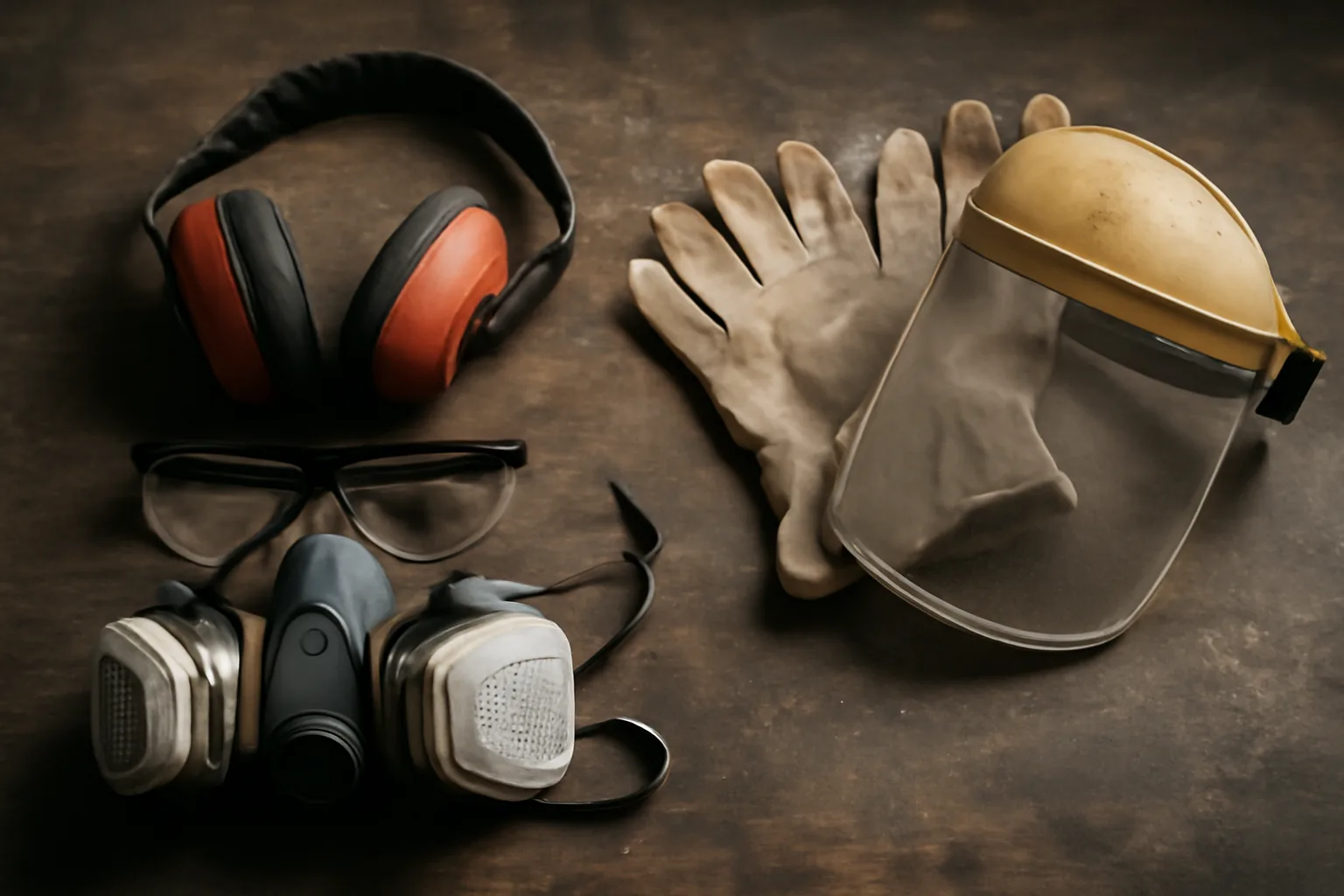
Here’s the honest truth about workshop PPE what to actually wear: most of us buy a bunch of safety gear with good intentions, use about half of it consistently, and let the rest collect dust on a shelf. I know because I’ve done exactly that. When I first built out my garage workshop six years ago, I dropped probably $300 on every piece of protective equipment I thought I needed. Respirators, face shields, chemical gloves, bump caps — the works. Within three months, I had a clear hierarchy. Some gear lived on my face and ears every single session. Other stuff got shoved in a drawer and forgotten. This post is my honest breakdown of which PPE actually earns its place in a working shop.
I’m not writing this as a safety officer reading off an OSHA checklist. I’m a hobbyist metalworker who welds, grinds, cuts, and sands in a two-car garage workshop. I’ve got roughly 1,500 hours of shop time logged across tool restoration, custom furniture builds, and a handful of structural projects. That experience taught me which hazards are constant and which ones only show up occasionally. That distinction matters a lot when you’re deciding what to grab before you fire up a grinder versus what to reach for only when you’re spraying primer.
This isn’t a gear list built around liability. It’s built around reality. I’ll tell you what I wear every single time, what I wear situationally, and what I bought once and genuinely never needed. I’ll also be upfront about a few mistakes that cost me — including one that left me with tinnitus flare-ups for three weeks straight.
The PPE I Reach for Before I Even Think About Starting
Two things go on every single time without exception: eye protection and hearing protection. Everything else varies by task. But these two? They’re non-negotiable before I flip a single switch. The risks they guard against are immediate, irreversible, and genuinely common in a metalworking environment.
Eye Protection: The One That Almost Got Me
I learned the hard way about skipping safety glasses — specifically during a wire wheel session on an old hand plane body back in 2020. I had my welding helmet nearby, felt lazy, and figured I’d just squint. A wire bristle broke off and hit me about a centimeter below my left eye. It didn’t penetrate, but it drew blood and scared me badly enough that I’ve never skipped eye protection since.
For grinding and cutting, I wear ANSI Z87.1-rated safety glasses as a baseline. That’s the American National Standards Institute impact rating — it means the lenses and frames have been tested against high-velocity particle impacts. For grinder work specifically, I add a face shield over the top. The combination covers splatter, sparks, and grinding debris that flies at angles safety glasses alone won’t catch. My current daily glasses are the DeWalt DPG82-11 wraparounds. They fog occasionally in summer, but the anti-fog coating holds up better than cheaper options I’ve tried.
When I’m welding, I run an auto-darkening helmet rated at shade 9 to shade 13. For MIG on thinner stock, I typically land at shade 10. For flux-core on thicker plate, I bump it to 11 or 12. The auto-darkening feature isn’t a luxury — it’s a functional upgrade that lets me position accurately before the arc starts. I won’t go back to a fixed-shade lens.
Workshop PPE What to Actually Wear for Hearing Protection
This is the category I messed up the longest. For my first two years in the shop, I was using cheap foam earplugs inconsistently. I’d roll them, insert them too fast, and get maybe 60% of their rated protection because of poor seal. Then came an angle grinder session — about 45 minutes straight — where I forgot plugs entirely. That’s when the tinnitus started. It lasted three weeks before fading. Hearing loss doesn’t announce itself dramatically. It just quietly accumulates until one day your audiologist shows you a chart and your 4,000 Hz range is gone.
A typical angle grinder runs between 90 and 100 dB at the operator’s ear. OSHA’s permissible exposure limit under 29 CFR 1910.95 is 90 dB for 8 hours — but at 100 dB, that limit drops to just 2 hours. In a hobby shop, we often grind for shorter bursts, but we also chain tasks together without thinking about cumulative exposure. That adds up faster than you’d expect.
Earmuffs consistently outperform earplugs for me in practice because there’s no insertion technique to mess up. You put them on, they seal, you’re protected. That reliability is worth a lot. For earplugs to achieve their rated NRR, they have to be inserted correctly every single time. Most people — myself included for years — don’t do that.
The Earmuffs I Actually Use: 3M PELTOR X4A
About two years ago I switched to the 3M PELTOR X Series X4A Over-the-Head Earmuffs and they’ve become the piece of PPE I’m most consistent about wearing. The X4A carries an NRR (Noise Reduction Rating) of 27 dB. That brings a 100 dB grinder down to a safe 73 dB equivalent at the ear — well below any exposure threshold for typical shop sessions.
What I like most about these is the balance between attenuation and wearability. The ear cushions are comfortable enough for two-hour sessions without creating pressure fatigue. The headband sits over the head without interfering with my welding helmet when I swap back and forth between tasks — that’s a real practical consideration that cheaper muffs don’t accommodate well. They’re also durable. Mine have been dropped, hung on a nail, and exposed to a fair amount of shop grime. The seals are still intact and the NRR hasn’t degraded as far as I can tell.
The X4A runs around $25 to $30 on Amazon depending on timing. For that price, there’s no reason to be using worn-out foam plugs. If you want maximum attenuation — say, you run a loud compressor alongside power tools in a small enclosed space — step up to the 3M PELTOR X5A, which jumps the NRR to 31 dB. The X5A is bulkier and the clamping pressure is noticeably higher, so it’s not as comfortable for long sessions. However, if you’re regularly running machinery above 100 dB in a small shop, those extra 4 dB points matter.
Respiratory Protection: When It Matters and When It Doesn’t
Here’s where I see hobbyists go one of two ways. Some wear a respirator for everything. Others wear nothing and call themselves fine. The honest answer sits in between — and it depends on what materials you’re working with, not just what process you’re running.
For basic mild steel grinding and MIG welding in my shop, I rely on shop ventilation — a 20-inch box fan pulling air out through one bay door and fresh air entering from the other side. That setup provides adequate dilution ventilation for short sessions. Welding fumes from mild steel contain iron oxide and manganese. Manganese exposure is the one to watch — OSHA’s PEL for manganese fume is 1 mg/m³ as a ceiling value. With proper ventilation and session lengths under an hour, I’m not reaching dangerous concentrations in my space.
That said, I pull out my 3M 6502QL half-face respirator with P100 and OV cartridges (that’s particulate plus organic vapor) in three specific situations: when I’m grinding or cutting galvanized steel, when I’m working with any coated or painted metal of unknown composition, and when I’m spraying any finish. Galvanized steel releases zinc oxide fumes when heated — that causes metal fume fever, which feels like a bad flu and hits within hours. It’s entirely preventable. Wearing a respirator for those jobs isn’t optional in my shop.
What Lives in My Drawer Instead
My chemical-resistant apron. My bump cap. A pair of cut-resistant gloves rated for ANSI A4 that I bought for sheet metal work and have used maybe four times. These aren’t bad products — they just cover scenarios that rarely come up in my specific workflow. If your work involves regular sheet metal forming or chemical handling, those items absolutely have a place. For me, they represent aspirational PPE buying rather than practical PPE buying.
Welding gloves, however, are the exception. They live on my bench, not in a drawer. I wear them for any welding or plasma cutting work without fail. Burns from slag and spatter happen fast and without warning. Leather welding gloves — mine are Lincoln Electric’s K2979 model — provide enough thermal protection without the clumsy loss of dexterity you get from heavier gloves. They cost around $20 and have lasted me two years of regular use.
The Gear I Underrated When I Started
Anti-fatigue mats and proper footwear don’t read as exciting PPE, but after 200-plus hours on a concrete floor, both became priorities. Concrete is unforgiving over long sessions. Lower back fatigue compounds concentration lapses, and concentration lapses cause accidents. I run a 3/4-inch thick anti-fatigue mat in front of my welding table and another in front of my bench grinder. The difference in end-of-session fatigue is measurable.
Footwear matters specifically because of dropped stock. I work with plate steel, bar stock, and heavy castings regularly. My shop shoes are steel-toed Red Wing 6-inch work boots — ASTM F2413-18 rated for impact and compression. That standard requires the toe cap to withstand a 75 foot-pound impact and 2,500 pounds of compression. A 10-pound piece of bar stock dropped from 18 inches delivers roughly 15 foot-pounds of energy — that cap handles it. Without it, you’re looking at crushed metatarsals and a very long recovery.
Fire-resistant clothing is the third underrated item. I don’t wear a full FR suit — that’s overkill for most hobby welding. However, I stopped wearing synthetic fabric shirts in the shop years ago. Synthetics melt rather than char, which means a spatter hit that would otherwise leave a small burn on cotton turns into a significantly worse injury on polyester. Natural fiber shirts — 100% cotton or denim — are the minimum for any welding or grinding session.
When to Call a Pro: Honest Limits for DIY Safety
Most hobbyist metalworking PPE decisions are DIY-manageable with basic research. However, there are legitimate situations where you need professional input. Specifically: if you’re working with materials you can’t positively identify — old industrial equipment, mystery alloys, or any pre-1980 metal components — get a material safety data sheet before you grind or cut anything. Beryllium copper, for example, is lethal in dust form. Lead-containing alloys exist in older hardware. You can’t eyeball your way to safety on unknown material.
If your workshop is fully enclosed with limited ventilation and you’re doing regular production-level welding, a professional industrial hygienist can assess your air quality and recommend appropriate controls. That’s not overkill — that’s knowing your actual exposure levels rather than guessing. OSHA’s Small Business resources and your state’s consultation programs often offer this at no cost for shops under a certain employee threshold.
Final Thoughts on Workshop PPE What to Actually Wear
The goal isn’t a perfect PPE collection. It’s consistent use of the right protection for your actual hazards. For me, that means eye protection and hearing protection — specifically the 3M PELTOR X4A earmuffs — every single session without exception. Add welding gloves and steel-toed boots for structural work, and a quality half-face respirator for anything with galvanized or coated materials. That core stack covers 90% of my real risk in this shop.
Knowing workshop PPE what to actually wear comes down to understanding your specific hazards, not buying everything on a generic safety checklist. Build your gear selection around your actual tasks, wear it consistently, and replace anything that’s degraded. A $30 pair of earmuffs that you wear every day beats a $150 set that sits on a shelf because they’re uncomfortable. Consistency is the whole game.
If you’ve got questions about specific gear for specific tasks, drop them in the comments. I’m happy to share what’s worked — and what hasn’t — from my end of the workbench.
This post contains affiliate links. As an Amazon Associate, I earn from qualifying purchases at no extra cost to you.