
You’ll find conflicting advice online about workholding: some folks swear that a quality vise solves every clamping problem, while others insist you need a Swiss Army knife collection of clamps and fixtures. The first camp is wrong, and here’s why — a vise is brilliantly specialized, which means it’s terrible at everything else. Once you understand what bench dogs and holdfasts actually do, you realize they solve an entire class of shop tasks your vise can’t touch, and they cost less than most people spend on a single clamp.
How Bench Dogs and Holdfasts Think Differently Than a Vise
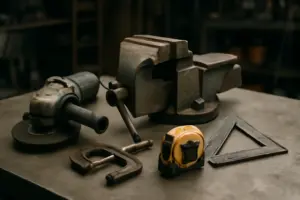
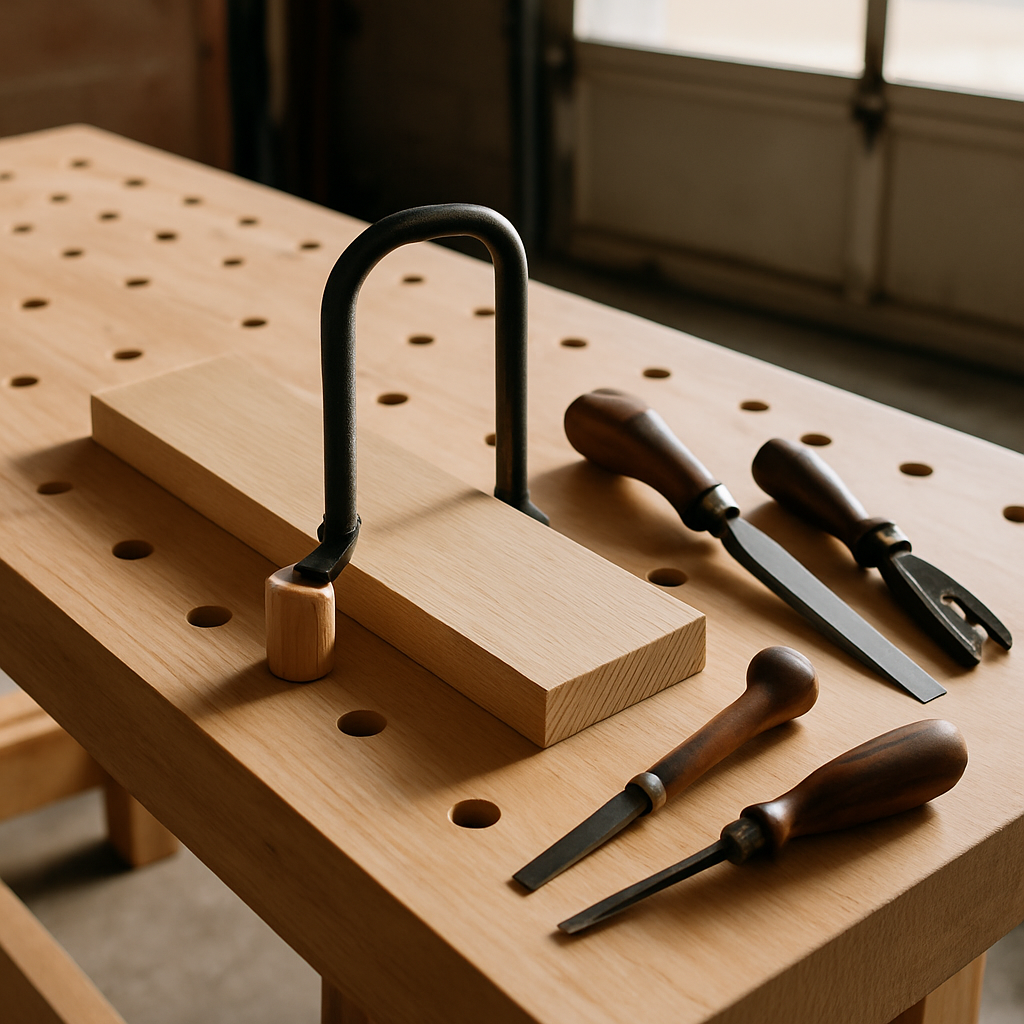
It took me longer than it should have to grasp this distinction: a vise operates as a compression tool. Two jaws squeeze a workpiece between them with tremendous leverage, making it excellent for sawing, filing, or drilling operations that demand immovable positioning. Yet vises come with real constraints. When you’re surfacing a wide plank, the jaws protrude above the benchtop like roadblocks in your plane’s path. A large, flat layout job means the vise can only grasp what hangs over its edges. And whenever you’re securing something with vulnerable details—ornamental corners, veneer edges, or a valuable antique’s original finish—you’ll crush the surfaces no matter how gently you tighten.
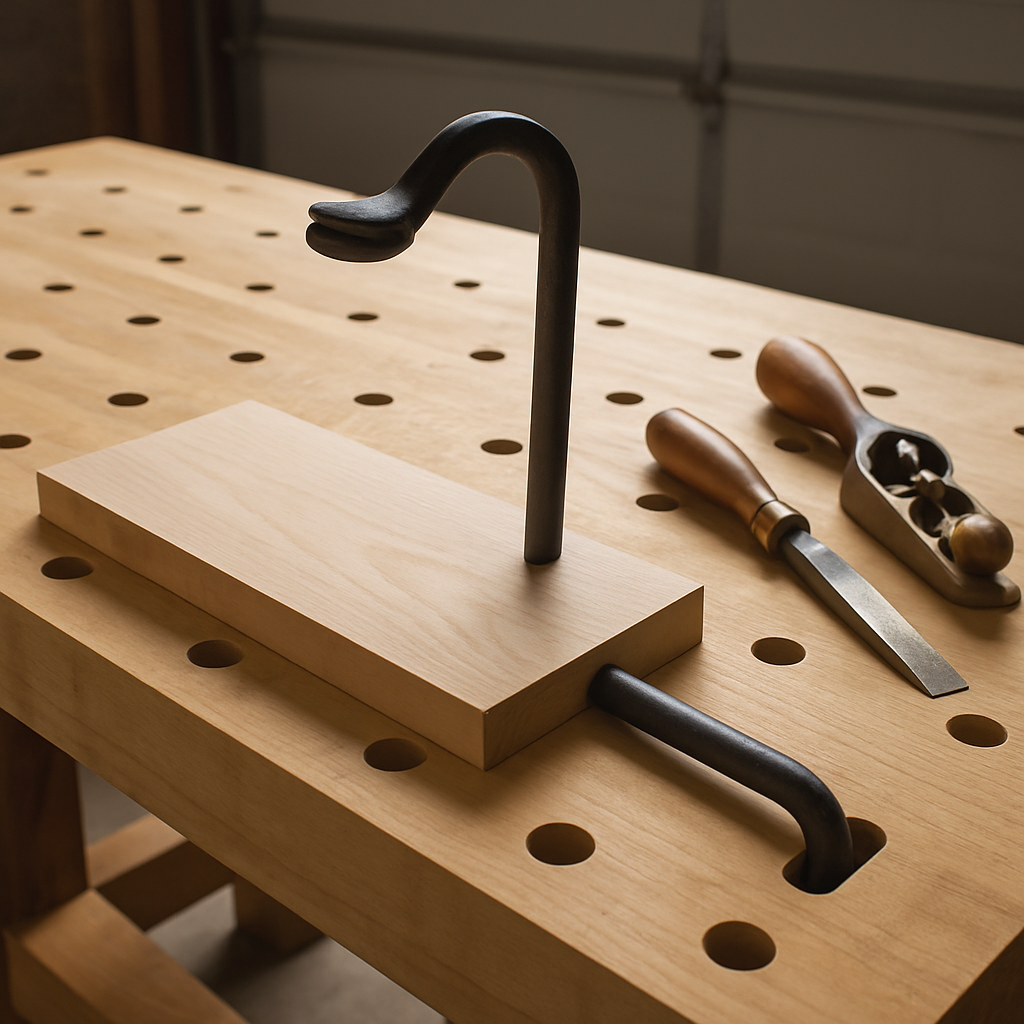
Dogs and holdfasts operate on entirely different physics. They leverage your benchtop’s weight and surface as the actual holding mechanism. Insert a dog into one of your bench’s holes, position your stock against it, and the combined friction between piece and bench keeps everything stationary. A holdfast—fundamentally an angled metal arm that pivots downward—engages a wedging action and depends on the bench’s thickness to apply pressure without any crushing contact. Throughout my own work, this approach means I can plane a board facedown without vise jaws obstructing the action, or apply pressure to the center of the benchtop where a vise would be helpless.
Drilling the Hole System That Transformed My Bench
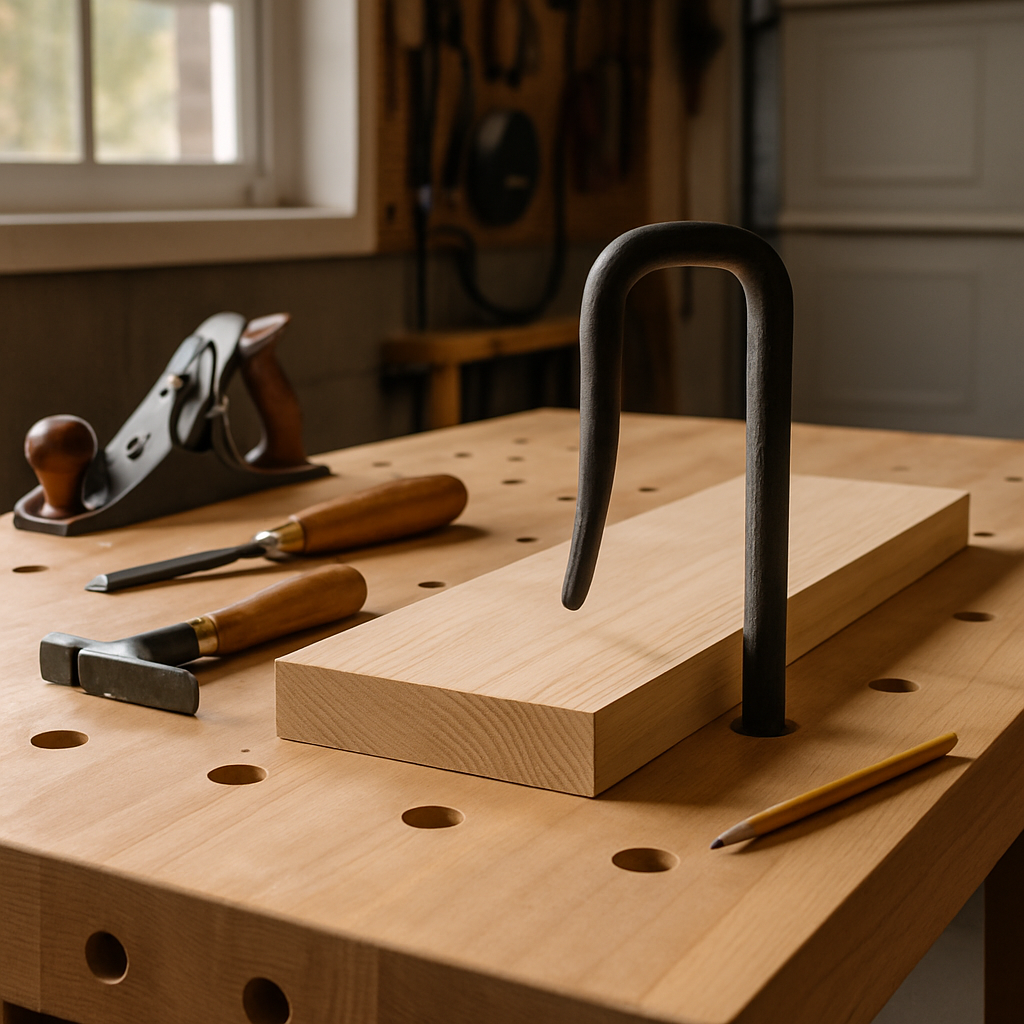
When I originally constructed my workbench over a decade ago, the result was a disaster—scrap 2×4 framing with plywood on top, and I’d never given a thought to drilling holes for dogs since I didn’t comprehend their purpose. Halfway through the bench’s life, a realization hit: this wasn’t actually a proper bench at all, merely a height-appropriate platform with no real functionality. The moment I committed to retrofitting dog holes, I measured out a 3/4-inch hole pattern in rows, keeping the first row 6 inches back from the front rail and then repeating the pattern in both directions at 4-inch intervals. I took my time with a Forstner bit, holding the drill as perpendicular as possible to the work surface.
Spacing precision matters less than many assume. Holes placed 4 inches from center to center provide tremendous versatility in positioning different jobs, though I’ve observed skilled shops operate effectively with 6-inch spacing too. Bench dogs themselves come dirt cheap—a basic wooden version runs under $3, while steel versions land in the $8 to $12 bracket. My initial purchase was a quartet of wooden dogs from a specialty woodworking retailer. These don’t need bells and whistles. The function remains elementary: occupy a hole, resist lateral drift of your board, disappear from view after the work finishes.
But the holdfasts—they were the genuine revelation.
Holdfasts: Strange Until You Understand Them
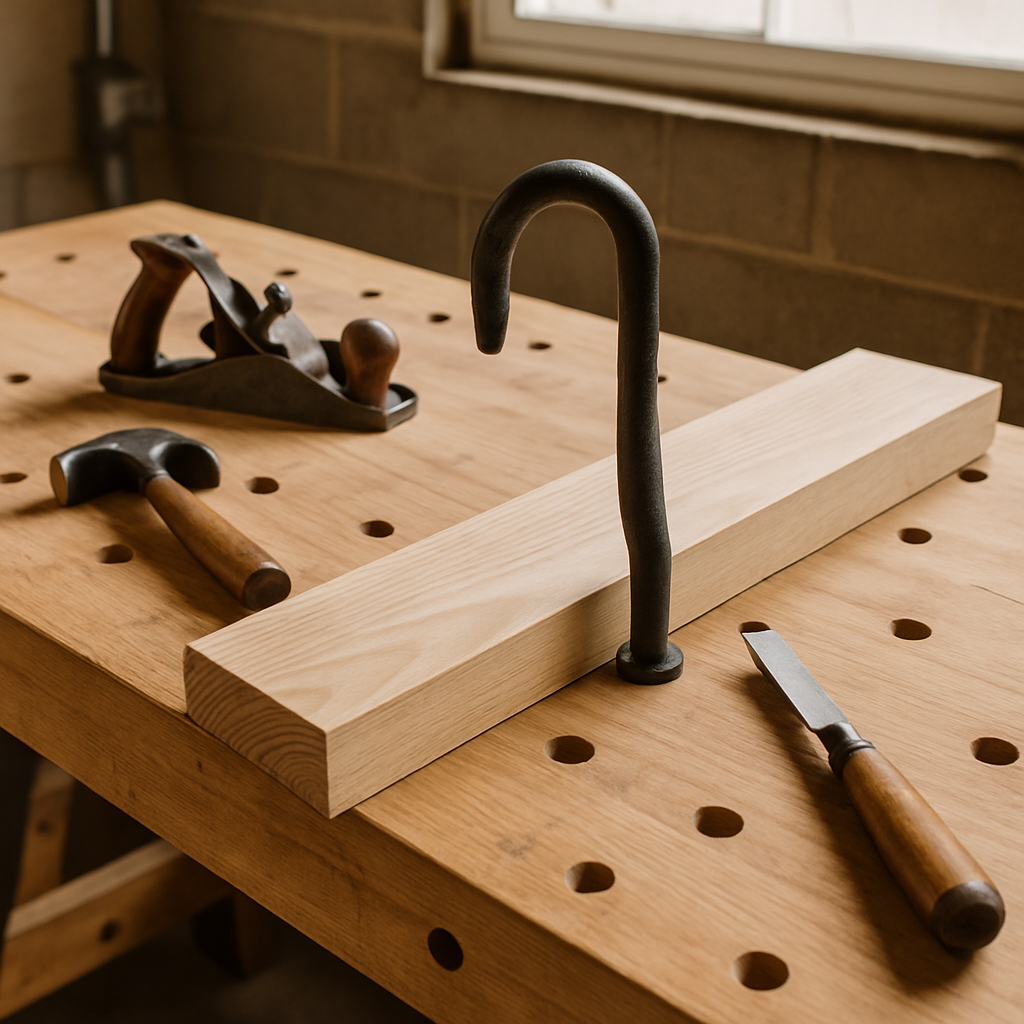
My opening experience with a holdfast left me convinced something was defective. You insert the arm down over your workpiece, rotate the handle toward the benchtop, and suddenly it clamps. The effect felt otherworldly, and I was certain I’d received a broken tool—the holding strength didn’t feel like the dramatic torque of a traditional clamp. I actually phoned a fellow woodworker and questioned whether my unit was faulty. His response? Laughter, followed by the suggestion to test it on an actual planing task.
He’d identified the core truth. A holdfast achieves clamping through leverage mechanics and contact friction, not brute-force compression like a vise. Engagement occurs as you shift the handle, which slightly raises the inner edge of the L-shaped arm while anchoring the outer edge against your work. Actual downward load emerges from gravitational pull plus the mechanical ratio of the lever arm. It seems gentle until you press down on your board with force and nothing shifts. The foundation here is hole placement—a standard 3/4-inch opening fits conventional holdfasts, and this hole must penetrate the full bench thickness (or reach deep enough for the wedging mechanism to function).
Years back, I acquired a pair of simple holdfasts through Woodcraft at approximately $28 apiece—pricing has fluctuated, but the current range spans $25 to $35. That represents extraordinary value for the capability. I’ve also come across vintage wooden holdfasts at flea markets and antique dealers, though these demand more experimentation to dial in properly. Cast steel models forgive operator error and persist indefinitely.
Practical Applications: Where This Makes a Tangible Difference
My planing workflow shifted dramatically with this system. Before, I’d wedge boards vertically into the vise, and anything over 18 inches became a wrestling match since the vise sits dead center on the bench. Now I position a dog ahead of the plane blade, align my board against it, and drop a holdfast behind the work. Your benchtop becomes the work-holding apparatus rather than two metal jaws. The planing surface stays unobstructed and level, and the tool glides without catching or wobbling.
Marking and layout operations saw perhaps even greater improvements. Previously: clamp, mark, unclamp, reposition, clamp again, mark again. Repeat. Today: flip one holdfast and you’re moving on. Conservation projects—which represent a significant volume in my two-car operation—benefit enormously from clamping without surface damage. A restoration of an original-finish blanket chest from the 1940s came through my shop a few months back, and the ability to keep it still without marring the paint while I stripped hardware and repaired structural joints was invaluable.
Even on the metal side of my work, these devices prove useful. While I’m not performing delicate welding at the bench, there are frequent occasions when metal stock needs to stay in position for grinding, boring holes, or scribe work. Holdfasts handle steel as efficiently as hardwood, and they’re quicker and less bothersome than cobbling together clamp arrangements.
Understanding What They Cannot Do
Dogs and holdfasts shouldn’t be mistaken for a vise alternative, and I need to highlight their limitations plainly. A holdfast has no mechanism to position and lock a workpiece at perpendicular angles the way a vise jaw can. For jobs requiring a part to stand at 90 degrees—think hot-metal welding or striking blows with force—you require a vise. Similarly, bench dogs won’t provide any holding ability if your benchtop has warped; the friction-based system that makes them work simply evaporates when the surface isn’t flat anymore.
The bench itself matters significantly. Thin or loosely constructed benchtops won’t function well with holdfasts because there’s insufficient thickness and structural stiffness. Mine measures roughly 2.5 inches and was constructed with the weight of a truck in mind—holdfasts work beautifully. An undersized or light bench will disappoint.
Additionally, there exists a modest learning phase with holdfasts. I observe people occasionally fighting them like standard clamps, then abandon them in frustration. They’re not difficult, but the wedging mechanism prefers a swift, confident push rather than a gradual tightening squeeze.
What I Tell People in the Shop
Assuming you have a robust benchtop and engage in regular planing, marking, or finishes-sensitive restoration, drill your grid of 3/4-inch holes at 4-inch spacing and invest in a couple of holdfasts alongside a dog set. Complete tooling runs under $100. Drilling takes roughly sixty minutes at a relaxed pace, keeping your bit alignment careful. Results arrive immediately.
This upgrade avoids complexity or extravagance. It’s probably the greatest low-dollar investment I’ve made to my work area because it eliminated an entire spectrum of holding challenges I was previously managing badly. And unlike a fresh clamp or premium vise, bench dogs and holdfasts demand no real estate and minimal care—they simply remain dormant until you need them. Across twelve years of operation, I haven’t had one regret about this choice.