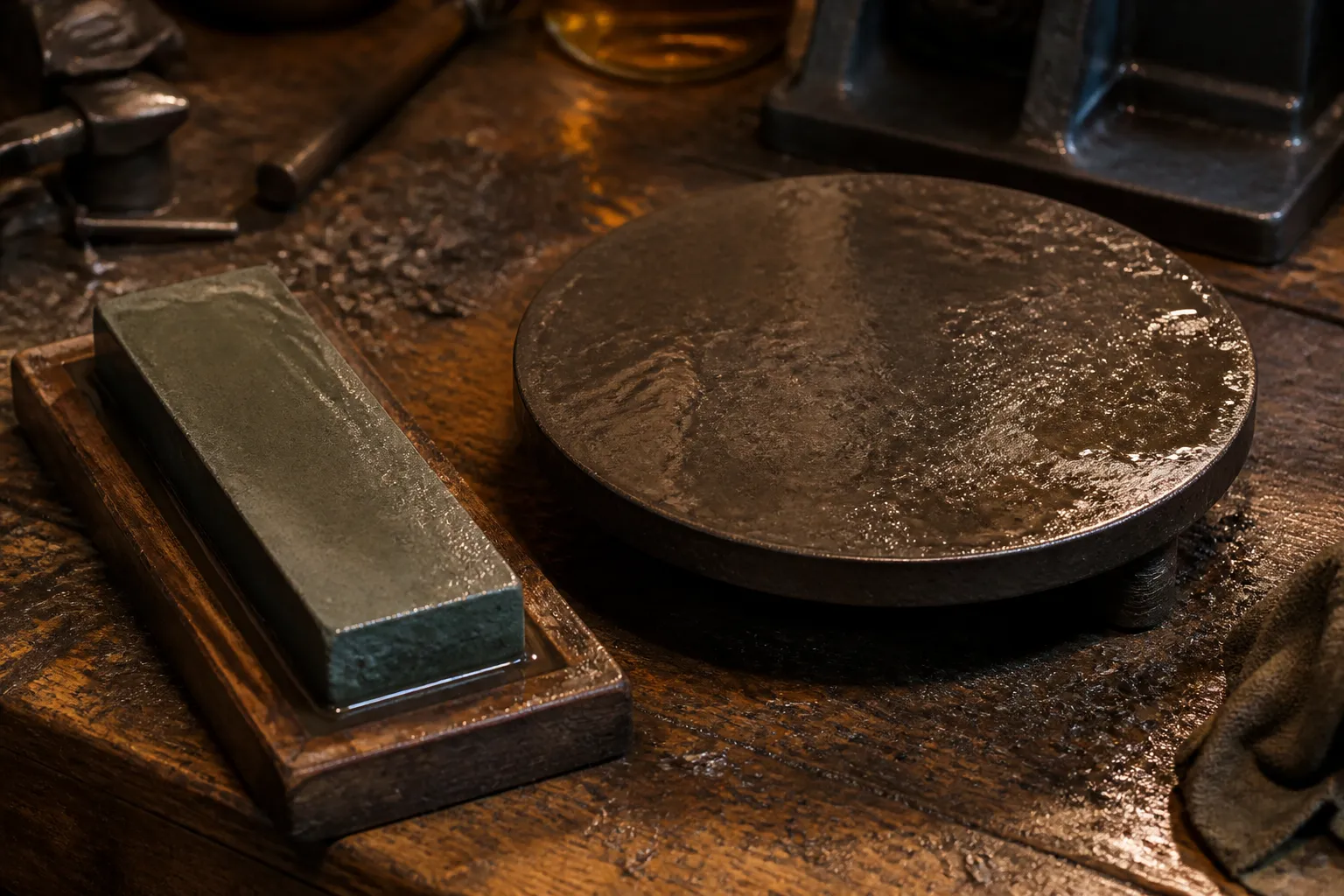
I ignored stone flattening for an embarrassingly long time. I kept chasing a wire edge that would not form evenly across a chisel, blaming my technique, my angle, the steel — and the actual problem was that my 1000-grit stone had quietly worn into a shallow dish in the middle. A hollow stone grinds a convex bevel no matter how good your form is. Once I started flattening properly I worked through three methods: wet/dry sandpaper on float glass, a dedicated flattening stone, and a diamond lapping plate. They are not interchangeable, and the cheapest one is not the false economy I expected it to be.
| Method | Cost | Flattening Time | Durability |
|---|---|---|---|
| Sandpaper on float glass | ~$20 | 40 minutes | Glass chips; sandpaper wears fast |
| Dedicated flattening stone | $60–$80 | 60–90 minutes | Outlasts water stones by years |
| Diamond lapping plate | $100–$150 | 15 minutes | Diamonds stay bonded; essentially never wears |
Why Your Stone Gets Dished in the First Place
Water stones wear fast. That is their whole personality — they cut aggressively, they sharpen quickly, and they erode with every stroke. The middle of the stone sees the most action because that is where you naturally work a blade. The edges get less traffic. Over months, that wear pattern becomes visible as a depression running down the center, sometimes subtle enough that you do not see it until you hold the stone to a light and look across it from the side.
The problem is insidious because the stone still cuts. You can still raise a burr. You can still get a sharp blade off it. What you cannot do is form a flat bevel — the hollow stone will always dish the back of your blade or chisel. In my shop, this meant I would spend twenty minutes chasing a wire edge that would only form on half the cutting edge. I thought I was holding the angle wrong. Turns out my 1000-grit King stone had enough dish to show daylight under a straightedge after about eighteen months of regular use.
The Three Methods: Sandpaper, Flattening Stone, Lapping Plate
Once I realized what was happening, I started experimenting with fixing it. Each method has real strengths and real limitations, and choosing between them depends on how often you sharpen and how much space you have.
Wet/Dry Sandpaper on Float Glass
This is the cheapest entry point. A piece of plate glass from a picture framing shop and a roll of 80-grit and 120-grit wet/dry sandpaper from an auto parts store will cost you about $20 total. You tape the sandpaper down, wet it, and work your stone across it face-down with circular motions until the entire surface shows wear. Then you step up to finer grits.
First time I tried this, I was shocked at how well it worked. A 1000-grit King stone that was dished maybe took forty minutes to flatten completely on 80-grit paper. The stone felt almost new afterwards.
The downsides are significant though. The sandpaper wears out fast on the harder stone grades — you are replacing it every few flattening sessions. The glass gets wet and slippery, which sounds minor until you are trying to keep a $60 water stone stable while scrubbing it. And if your shop temperature swings, the glass can develop condensation underneath, which is annoying to deal with. I stored my glass setup on edge in the corner and chipped a corner off it inside a year. Plate glass does not warp, but it does chip, and flat glass is only as useful as its flatness.
Dedicated Flattening Stones
There is a whole category of coarse, hard stones made specifically for flattening water stones. They are usually silicon carbide, around 120 to 220 grit equivalent, and they are designed to be flatter and longer-lasting than a sharpening stone. Naniwa and Shapton both make them. The idea is simple: rub the stone you want to flatten across the flattening stone with water, just like sharpening.
A good flattening stone costs $60 to $80 and will outlast your water stones by years. In my shop, the Naniwa 220-grit flattening stone I picked up six years ago has barely changed. I flatten my 1000-grit and 6000-grit stones about every two months, and the flattening stone shows almost no wear.
The catch is speed and labor. Flattening a dished 1000-grit water stone with a flattening stone takes longer — maybe sixty to ninety minutes if the dish is pronounced. You are doing sustained work, your arms get tired, and you have to stay focused because the task is monotonous enough that attention drifts. Also, flattening stones are not a one-tool solution — you still end up cleaning up with sandpaper on glass afterward if you want a truly flat result.
Diamond Lapping Plates
Diamond plates are a different beast. Instead of silicon carbide, they have diamonds bonded to a steel or composite plate. The most common sizes in a home shop are 6-inch by 2-inch or 8-inch by 3-inch, in grits from 120 to 600. A quality diamond plate costs $100 to $150, and as I covered when comparing diamond plates against water stones, the real value is that diamond plates essentially never wear flat. The bonded diamonds stay put.
First time I used a diamond plate to flatten, I was genuinely surprised. A plate that was visibly dished — I mean you could see the hollow without tilting it — took maybe fifteen minutes on my 120-grit diamond plate. Fifteen minutes. The diamond cuts so aggressively on the stone that it almost feels wrong, like you are doing something too fast and rough. But the result is flat.
The trade-off is that diamond plates are expensive, they take up shelf space, and they require water or oil to work. In a garage shop where space is precious, storing another tool is a real consideration. They also create significant slurry — a mix of stone particles, water, and diamond debris that gets everywhere. If you are planning a dedicated sharpening station, the diamond plate makes sense because you have containment, but if you are working ad-hoc on a bench, it is messy.
The Real Cost and Time Trade-Off
Here is what I actually do in my shop now, and why. I own all three methods because I have been here long enough to accumulate tools, but I use them in different situations.
The sandpaper-on-glass method is free and lives in my flattening rotation because I already have the materials. If I need to flatten a stone once every eight months and I do not mind spending time on it, this works. Cost per flattening is almost nothing. The problem is that I sharpen more than once every eight months.
The flattening stone is my go-to for maintenance. Every six weeks or so I will flatten my 1000-grit stone for fifteen or twenty minutes while listening to a podcast — routine maintenance stays quick precisely because the dish never gets deep enough to need the long session. It is not the fastest method, but it is predictable and it keeps the stone mostly flat. For someone who sharpens chisels and plane irons regularly but does not want to spend $150 on a diamond plate, a dedicated flattening stone is the rational choice.
The diamond plate is what I grab when I am in a hurry or when a stone has developed real dish. It flattens aggressively and does the job in a fraction of the time. The cost was hard to justify for years until I realized I was losing more time chasing a mediocre edge than the tool would ever cost me.
The last thing I do after any flattening is run the stone through the water one more time and then finish the edge with stropping to get that final sharpness. That part does not change regardless of which method I used to flatten.
What I Actually Recommend for Your Shop
If you are starting out and flattening is new to you, buy the sandpaper and glass first. $20 is nothing, and you will learn what flat actually feels like. Do it a couple times. Once you have sharpened enough to understand the rhythm, invest in a dedicated flattening stone from a maker like Naniwa or Shapton. It is the best middle ground — reliable, permanent, not expensive, and it will outlast several generations of your sharpening stones.
Only reach for the diamond lapping plate if you sharpen frequently enough that the speed saves you real time, or if you build a dedicated station where the mess is not a problem. It is a tool for someone who has already internalized that flattening is not optional, and who has the space and budget to own specialized equipment.
The actual answer to the lapping plate vs flattening stone question is that they are not competing. A flattening stone is maintenance. A lapping plate is acceleration. For most home workshops, the flattening stone does the job you need, and does it well enough that the extra cost of a lapping plate is not justified. But if you are grinding through edges constantly, or if you have one really good stone that you want to keep perfect, the lapping plate earns its place in the corner of your bench. I use mine at least once a month now, and I do not regret the purchase — but I also would not have bought it if a flattening stone had not already done the work for me first.
Frequently Asked Questions
How long does it take to flatten a dished water stone?
It depends on the method. Sandpaper on float glass takes about forty minutes for a dished 1000-grit stone. A flattening stone takes sixty to ninety minutes if the dish is pronounced. A diamond lapping plate flattens the same stone in about fifteen minutes.
What grit sandpaper should I use to flatten water stones?
Start with 80-grit wet/dry sandpaper, then step up to 120-grit to finish. Tape the sandpaper to float glass, wet it, and work your stone across it with circular motions until the entire surface shows wear.
How often should I flatten my water stones?
It depends on how much you sharpen. If you sharpen chisels and plane irons regularly, flatten every six weeks or so for routine maintenance. If you sharpen less frequently, every eight months may be enough. The goal is preventing deep dish from developing.
Are diamond lapping plates worth the cost?
Diamond plates cost $100 to $150 but flatten aggressively in a fraction of the time compared to other methods. They are worth buying if you sharpen frequently enough that the speed saves real time, or if you build a dedicated station where the mess is manageable.
About This Article

Written by Garrett Dunn. Hobbyist metalworker and garage workshop builder. I restore old tools, weld custom furniture, and document my projects and mistakes so other makers can learn from both. More about this site.
Scope and limits. Garrett is a hobbyist metalworker, not a certified welder or machinist. Welding, grinding, and solvent work carry real injury risk — use the correct PPE and ventilation, and follow the manufacturer safety guidance for your own equipment.
Verify this against a primary source
Specifics change, and your situation may differ from the one described here. These are the authorities worth checking directly:
- OSHA — machine guarding, PPE and shop safety standards
- American Welding Society — welding procedure and safety standards